


Habitat and Distribution – Rice Weevil (Sitophilus oryzae)
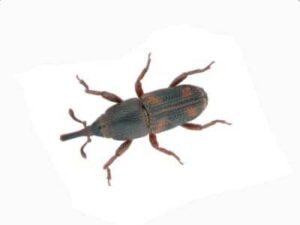 Although native to warmer climates, the Rice Weevil has become a fairly common occurrence in the UK due to international food trade. It is regularly imported into the country and is sometimes encountered in grain storage and food processing environments. Its presence is typically associated with infested products rather than local breeding, although under favourable conditions it can reproduce within British facilities.
Biology – Rice Weevil (Sitophilus oryzae)
The Rice Weevil has a life cycle that is very similar to that of the Grain Weevil (Sitophilus granarius), but it develops at slightly higher temperatures. The minimum breeding temperature is around 17°C, and at this temperature, the full life cycle takes approximately 13 weeks to complete.
This species can be distinguished from the Grain Weevil by several visual characteristics:
-
It is less shiny in appearance.
-
It has four more-or-less distinct orange patches on its wing cases (elytra).
The Rice Weevil can fly, unlike the Grain Weevil, although it is less active in flight than the Maize Weevil (Sitophilus zeamais), which flies more readily in high temperatures. The Rice Weevil and Maize Weevil are nearly indistinguishable without microscopic dissection, but such differentiation is rarely necessary due to their similar habits and equal pest status.
Why They’re a Problem – Rice Weevil (Sitophilus oryzae)
The Rice Weevil is a pest of concern in both the British grain trade and the processed food sector. Its ability to infest stored cereals—particularly imported rice and maize—means it can go undetected until significant contamination has occurred. It holds equal pest status to the Maize Weevil and is capable of reproducing in suitable storage conditions.
Control and Prevention – Rice Weevil (Sitophilus oryzae)
Control of the Rice Weevil follows the same approach used for managing the Grain Weevil. Effective control relies on:
- Exclusion: Preventing adult beetles from accessing new, uninfested food products suitable for egg-laying.
- Monitoring and cleaning: Regular inspection and sanitation to detect and remove infested materials.
- Residual treatments: Using approved insecticides in storage areas and around potential harbourage points.
- Fumigation: In cases of established infestations, fumigation by trained specialists may be necessary.
Exposed adult infestations are relatively easy to manage if early action is taken and access to fresh food sources is restricted.
Professional Support – Rice Weevil (Sitophilus oryzae)
If you’re dealing with suspected Rice Weevil activity in your grain storage or food processing facility, Pest Solutions can help. Our experienced team offers identification, monitoring, and treatment services for all stored product pests.
Visit https://www.pestsolutions.co.uk to book an inspection or request expert advice.


