


Bird Control Manchester Experts on Common Local Pest Bird Species
The different pest species found across White Gate each demand their own thoughtfully considered strategy. Which bird species is present determines the legal standing, the chosen method of control, and the timeframe in which the work must be carried out. What follows reflects the situations our bird control team encounters most often across Manchester.
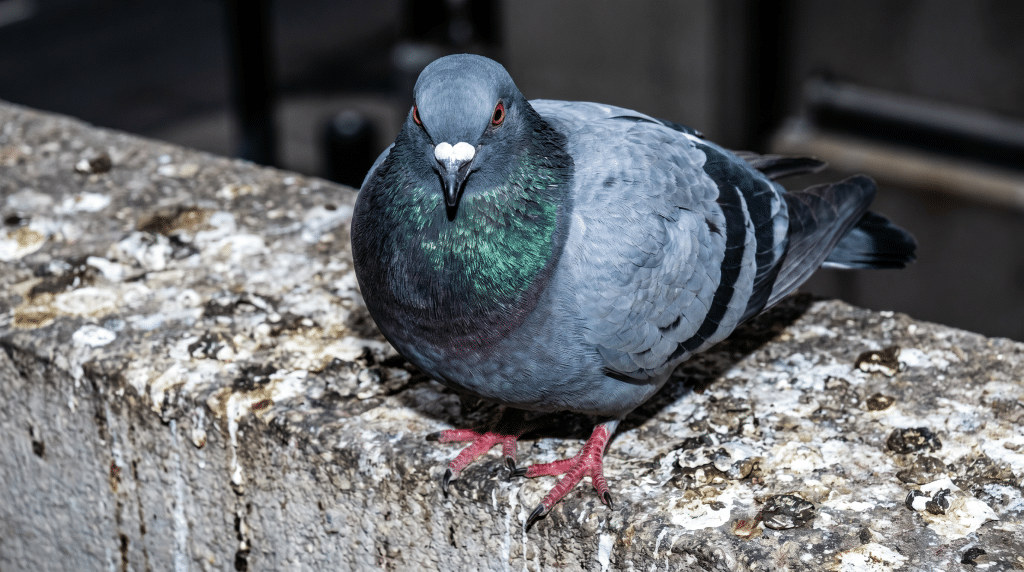

Feral pigeons (Columba livia)
Feral pigeons reign supreme as the number one bird pest right across White Gate city centre and throughout the industrial estates and retail parks that extend across the Manchester area. For example, Piccadilly Gardens has been home to a remarkably dense, year-round pigeon population for decades now, and from there these birds have steadily spread outwards to commercial rooftops, multi-storey car parks, railway arches, and enormous warehouse units all across the region!
Left uncontrolled, a lone breeding pair is capable of producing multiple broods throughout the span of a year, meaning that an unmanaged pigeon roost occupying a ledge space or roof void can escalate into a major bird infestation within only two breeding seasons.
Bird fouling from feral pigeons is corrosive. Left to build up, it harms roofing membranes and obstructs drainage channels, whilst contact with metal fittings and structural steelwork speeds up corrosion over time. Feral pigeons are not protected under the Wildlife and Countryside Act 1981, so pest control treatment and deterrent work can go ahead without a licence. Our pigeon control service offers the full range of exclusion and deterrence methods.
Gulls (Laridae)
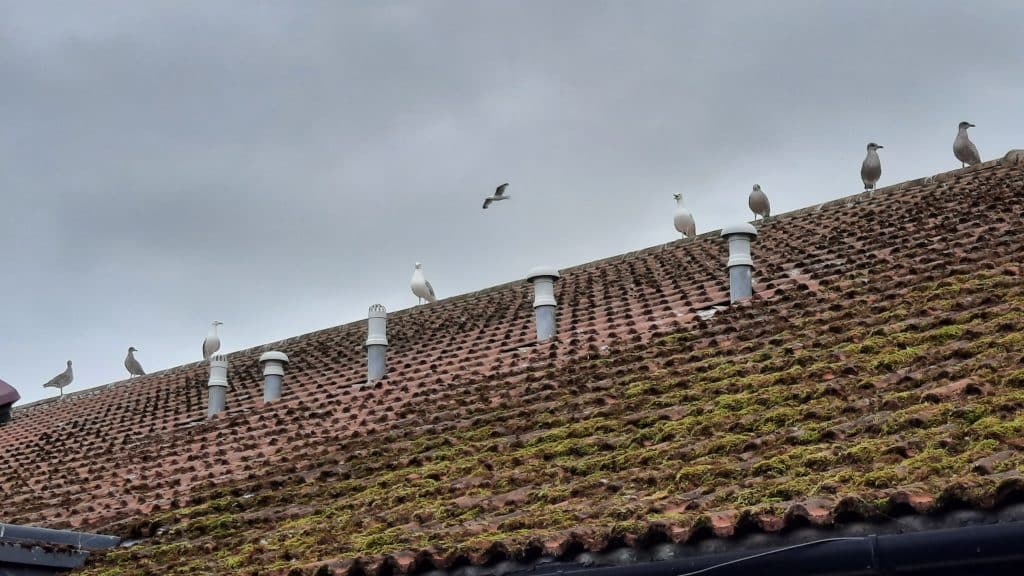
Gull populations have been migrating consistently inland across Manchester for several years. Both herring gulls and lesser black-backed gulls have set up nesting colonies on flat commercial rooftops throughout the White Gate area, attracted by the abundance of food waste generated by restaurants, retail parks, and waste handling sites, as well as the residual warmth that large warehouse rooftops retain during the breeding season.
Nesting gulls grow increasingly protective and territorial over their chosen sites, meaning that long-standing colonies can pose a real safety risk to maintenance personnel carrying out routine roof access work.
Seagulls are protected under the Wildlife and Countryside Act 1981, meaning active nests cannot be disturbed without a licence. Natural England issues general licences, including GL41 for public health and safety, permitting approved pest control companies to carry out specific control activities.
Our gull control service works completely within the boundaries of the established legal framework, advising clients on the lawful courses of action open during the current season whilst identifying appropriate deterrent systems to prevent birds from returning to the same rooftop in the year that follows.
Starlings, sparrows, and corvids
Starling roosting leave fast and significant fouling on business properties throughout autumn and winter across White Gate, and dried starling guano presents the same health hazards as pigeon droppings.
House sparrows nest in roof voids and beneath loose fascias on housing and commercial properties all throughout White Gate. They both carry legal legal protection, so the timing and method absolutely matter!
Carrion crows, jackdaws and magpies are corvids you will regularly see on industrial sites throughout Greater Manchester, and when these birds build nests inside chimneys or flues they pose a serious fire hazard that must be addressed outside of the nesting season. We spot pigeons and any other pest bird species present during our survey and then structure the entire programme around the specific legal protections that are relevant to each one.
Bird Control Services Throughout White Gate
Our pest control technicians conduct a thorough inspection prior to recommending any bird control solutions. The species of bird being deterred, the property type, and the extent of the infestation all determine the appropriate specification. The majority of commercial projects require a combination of bird control methods rather than one single solution, because pest birds will move to nearby surfaces once a landing point has been closed off. The range of services outlined below comprises everything we deploy across White Gate and the surrounding areas.

Bird netting
Bird netting provides full exclusion across expansive open spaces, from loading bays and roof voids to canopies and internal courtyards where pigeons congregate to nest and roost in significant numbers. A properly specified netting system blocks all bird access to the protected area and remains effective for a decade when following periodic inspection. Our pest control technicians carry PASMA and IPAF certifications ensuring secure installation at height on White Gate’s larger commercial and industrial buildings, a capability that many local pest control providers simply cannot match. Pigeon-grade and gull-grade netting are manufactured with different mesh apertures, and selecting the incorrect gauge allows birds to move through the gaps within days of the installation being completed.
Bird spikes
Bird spikes are used to discourage pest birds from roosting upon raised ledges, parapets, window sills, signage, and roof ridges. The particular specification selected depends upon both the width of the surface in question and the species needing control, with denser and narrower arrays suited to smaller birds whilst wider spacing accommodates pigeons and gulls. A humane solution through and through. The blunt-tipped prongs leave any surface thoroughly uncomfortable to roost on, whilst causing absolutely no harm to the birds themselves.
Bird wire and post systems
Bird wire systems operate by tightening tensioned stainless steel wire between discreet slimline posts, forming an unstable landing surface across broader ledges and stone sills where spike systems would appear far too conspicuous. The installation carries minimal visual weight when observed from street level, making it the most appropriate solution for visible commercial frontages and heritage buildings throughout White Gate city centre. Wire systems prove highly effective as a bird deterrent against gulls in particular, as these birds struggle to make reliable use of an unstable surface beneath them.
Audible and visual bird scarers
Audible bird scarers emit predator calls and distress signals at varying intervals to discourage birds from settling across a site. Visual scarers display realistic replicas of birds of prey to make rooftops and ledges feel threatening and unwelcoming. Both forms of bird deterrent system perform most effectively when used in combination with physical exclusion measures, as birds will slowly grow accustomed to a solitary scarer operating on a predictable cycle and will ultimately cease to respond to it altogether.
Falconry
Our falconry visits dispatches trained hawks and birds of prey out to scare off established pest bird populations from open commercial sites. The presence of a live bird of prey disrupts roosting and nesting behaviour more effectively than static bird control measures across broad open rooftops and outdoor areas. Falconry visits are carefully scheduled throughout the breeding season and continue until the site is no longer being used as a roost. The handler logs every single visit and provides written compliance records if requested.
Bird nest removal and trapping
Live bird nests are safeguarded by the Wildlife and Countryside Act 1981, though once the nesting season draws to a close, any remaining nests must be cleared before deterrent measures can be installed. Previous nesting material is a haven for parasites and carries the lingering scent that draws birds to return to the very same spot season after season. Our licensed technicians will take away the nest, thoroughly clean the area of guano and debris, and fit the appropriate deterrent systems all within a single visit. Where pigeon populations prove too large for deterrents alone to manage effectively, a carefully targeted bird trapping programme can reduce their numbers sufficiently for exclusion measures to take hold. Trapping programmes typically run for a period of between six and eight weeks.

Bird fouling removal
Collected bird guano calls for treatment as a hazardous material at the point of removal. Dry droppings break up into an airborne dust capable of carrying Salmonellosis and other dangerous pathogens when inhaled by anyone cleaning without proper respiratory protection. Our bird fouling removal service thoroughly clears and disinfects every affected area before any exclusion work commences. This important pre-cleaning stage gets rid of the biological scent that would otherwise draw birds straight back through gaps in a freshly installed deterrent system.
Why Pest Bird Problems Cost More Than They First Appear
Bird guano is extremely acidic to result in severe deterioration of a flat roof membrane within just one season. The impact of an unmanaged bird infestation across a White Gate commercial property spread through drainage systems, structural steelwork, electrical equipment and fire safety infrastructure, creating associated costs that often exceed the expense of the bird control measures themselves.
Structural damage and guano corrosion
Solar panels on commercial premises across Greater White Gate present a significant pest threat. Bird droppings and nesting material clog drainage channels, forcing water into the building fabric below. Guano accumulates beneath panel arrays, obstructs drainage, and nesting debris packed around electrical connections or junction boxes creates a fire hazard that most owners only identify during a routine maintenance inspection.
Fire risk from nesting materials
Nest sites located inside roof voids, chimney flues, or close to electrical wiring pose a genuine fire hazard. Dry nesting material is highly combustible, and nests found near junction boxes or beneath rooftop plant equipment are a frequent occurrence across White Gate’s existing industrial and commercial properties. Clearing accumulated nesting material during the autumn window between breeding seasons eliminates this risk well ahead of the winter months that follow.
Disease and health risks
Avian species are recognised vectors of more than 60 distinct conditions. Salmonellosis, E. coli, Campylobacter, Psittacosis, Cryptococcosis, and Histoplasmosis are the most often documented illnesses associated with pest bird fouling and nesting debris. Histoplasmosis is a fungal infection caused by airborne spores contained in dried droppings, and the associated health risk becomes most acute when guano is disturbed through cleaning operations conducted without appropriate respiratory protection in place.
For food businesses and leisure operators throughout White Gate, bird presence around loading areas, kitchen vents, or open food storage areas represents both a compliance matter and a serious health concern. An environmental health inspection that identifies bird fouling or nesting material in proximity to food production zones can lead to an improvement notice being issued, or a requirement to cease operations whilst remedial work is carried out.
Secondary infestations
Nest debris and bird fouling are well established attractants for secondary pest populations. Fleas and bird mites that become established within nesting debris will move into the building once the birds depart at the the close of the season, whilst the warmth generated by accumulated guano and its organic content brings in further insect activity. Addressing the nesting site as part of an regular programme reduces this secondary pest risk before it has the opportunity to move indoors.

Commercial Bird Pest Control Service Across White Gate
Commercial bird pest control in White Gate covers catering businesses, hospitality venues, retail, healthcare, warehousing, and the widespread industrial and logistics facilities across Greater White Gate and into Cheshire. The majority of our commercial engagements are conducted in close co-operation with facilities managers and dedicated property teams. Arranging work outside of standard business hours is a routine service we provide, and comprehensive written compliance documentation is provided as an integral component of every assignment. Our technicians conduct all work with the utmost discretion, particularly on premises where customer footfall remains a primary consideration.
Pest Solutions provides rodent control, insect treatments, wasp nest removal, and commercial pest contracts throughout White Gate, meaning commercial clients dealing with multiple pest challenges have the benefit of managing all their requirements through one dedicated pest control provider.
Our enterprise bird control programmes are founded on the principles of integrated pest management (IPM), weaving together access prevention, deterrence, and population management into one cohesive and site-specific strategy. For business properties requiring a more sustained approach, we offer ongoing pest management contracts that bring together scheduled surveys, prompt emergency response between visits, and detailed written reports prepared for environmental health or insurance purposes.
Our commercial bird control programme kicks off with a completely free site survey! We then pinpoint the most suitable methods for your specific property and schedule all installations to work smoothly around your live operations. Full written records of every single piece of work carried out are provided, keeping you covered for both compliance and insurance purposes. The whole programme is built with long-term control firmly in mind: deterrents are specified to last a full decade, scheduled inspections are arranged to catch any new pressure early, and documented evidence of every visit is kept securely on file.