


Bird Control Manchester Experts on Common Local Pest Bird Species
Various pest bird species found across Uppermill each require a tailored response. The specific bird species involved determines the legal standing, the control method we recommend, and the timeframe within which the work must be completed. Below is a summary of the bird species our control team most frequently encounters throughout Manchester.
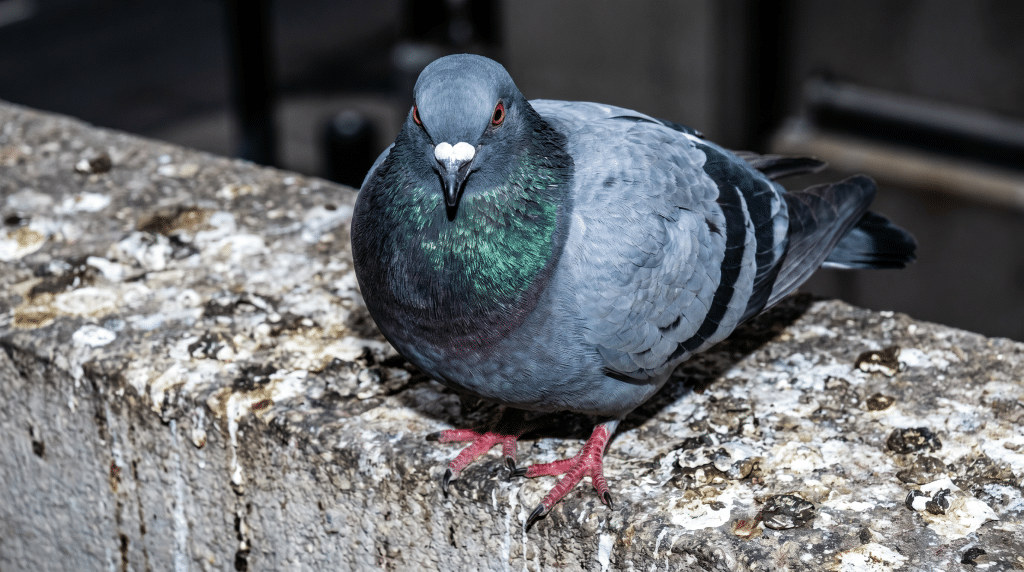

Feral pigeons (Columba livia)
Feral pigeons remain the primary bird pest across Uppermill city centre and the industrial estates and retail parks across Manchester area. For example, Piccadilly Gardens has sustained a dense, year-round pigeon population for decades, with birds extending outward to commercial rooftops, multi-storey car parks, railway arches, and large warehouse units across the region.
An mature breeding pair can produce several broods across the year, and a pigeon roost left unchecked within a ledge space or roof void will develop into a complete bird infestation over just two breeding seasons.
Bird fouling from feral pigeons is acidic. If allowed to accumulate, it can damage roofing membranes and blocks drainage channels, whilst contact with metal fittings and structural steelwork increases corrosion over time. Feral pigeons are not protected under the Wildlife and Countryside Act 1981, so pest control treatment and deterrent work can proceed without a licence. Our pigeon control service covers the full range of exclusion and deterrence methods.
Gulls (Laridae)
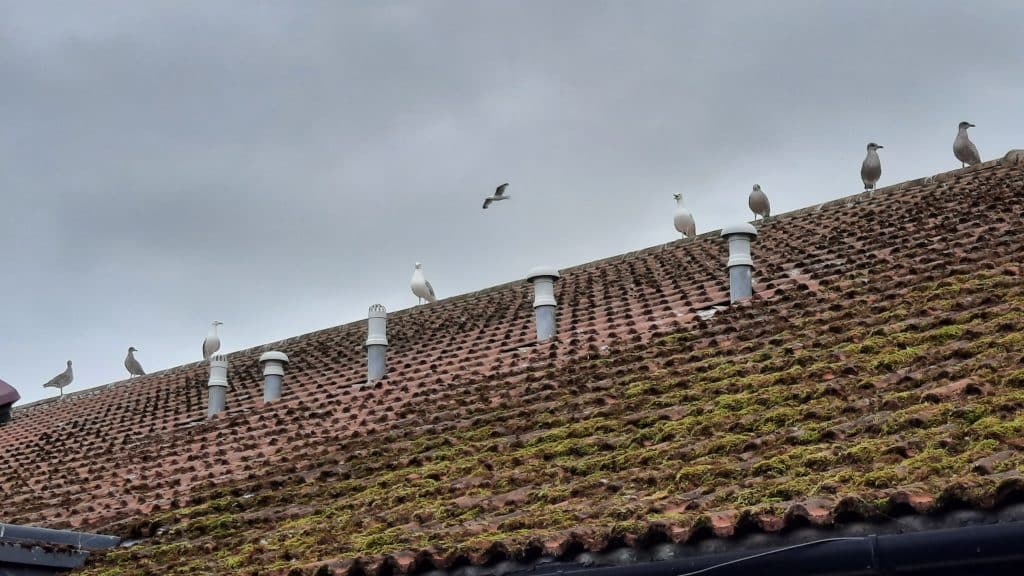
Across the expanse of Uppermill, gull populations have been making a slow migration inland throughout many years, and this subtle but persistent shift tells a story all its own. Herring gulls and lesser black-backed gulls have taken to nesting upon the flat rooftops of commercial buildings throughout the Uppermill area, lured by the copious food waste generated by restaurants, retail parks, and waste handling sites, as well as the warmth that vast warehouse rooftops hold near through the duration of the breeding season.
While nesting, gulls grow increasingly defensive and defensive in behaviour, and well established gull colonies can make routine roof access truly hazardous for maintenance personnel.
Under the Wildlife and Countryside Act, gulls are afforded legal protection, meaning that any active nest must stay undisturbed unless a licence has been secured. Natural England issues general licences, including GL41 which covers public health and safety, authorising licensed pest control companies to undertake specific control activities.
Our gull control service operates strictly in line with the limits of the law, advising you on what measures are authorised during the current season whilst identifying the best deterrent systems to stop birds from returning to the same rooftop the following year.
Starlings, sparrows, and corvids
Starling nesting sites lead to rapid and heavy fouling on commercial buildings throughout autumn and winter across Uppermill, and dried up starling guano carries exactly the same risks to health as pigeon droppings!
Domestic sparrows frequently establish their nests within roof voids and beneath unsecured fascias across household and business properties across Uppermill. As a safeguarded species, the timing and method of any work must be thoughtfully assessed and correctly managed.
Carrion crows, jackdaws and common magpies are corvids you will often encounter on industrial sites throughout Greater Manchester, and when these birds construct nests inside chimneys or flues they pose a genuine fire hazard that must be addressed outside of the nesting season. We identify pigeons and any other pest bird species present during our survey and then plan the entire programme around the specific legal protections that are relevant to each one.
Bird Control Services Throughout Uppermill
Our pest control technicians conduct a thorough inspection before suggesting any bird control solution. The bird species involved, the building type, and the scale of the infestation all determine the specification. Most commercial jobs require a combination of bird control methods rather than a single solution, because pest birds simply move to adjacent surfaces once a landing point is removed. The services listed below cover everything we deploy across Uppermill and the surrounding areas.

Bird netting
Bird netting provides full protection across broad open areas, including loading bays, roof voids, canopies, and internal courtyards where pigeons nest and roost in large numbers. A properly chosen netting system blocks all bird access to the designated area and will last for a decade when subject to periodic inspection. Our pest control technicians hold PASMA and IPAF certifications facilitating safe installation at height on Uppermill’s higher commercial and industrial buildings, a capability that numerous local pest control providers are simply unable to offer. Pigeon grade and gull grade netting require different mesh apertures, and selecting the incorrect gauge will allow birds to exploit gaps within a few days of the installation being completed.
Bird spikes
Bird spikes serve to deter pest birds from settling on ledges, parapets, window sills, signage, and roof ridges. The appropriate specification of bird spike is determined by both the width of the surface in question and the species requiring management: more compact arrangements are appropriate to smaller birds, whilst wider spacing is more appropriate for pigeons and gulls. Bird spikes offer a humane and considered approach to bird control. Their blunt-tipped prongs leave the surface sufficiently uncomfortable to discourage landing or roosting, whilst causing no actual harm to the birds themselves.
Bird wire and post systems
Bird systems employ taut stainless steel wire run between discreet low-profile posts, engineering an unreliable landing surface across wider ledges and stone sills where spike systems would present an unacceptable visual intrusion. The installation carries an exceptionally minimal footprint when viewed from street level, establishing it as the preferred solution for visible commercial façades and heritage buildings throughout Uppermill city centre. Wire-based systems remain particularly effective as a deterrent against gulls, which find it difficult considerably to make reliable use of an unstable and unstable surface.
Audible and visual bird scarers
Audible bird scarers broadcast predator calls and distress signals at different intervals to discourage birds from settling on a site. Sight-based scarers deploy replicas of birds of prey to cause a rooftop or ledge feel more intimidating. Both types of bird deterrent systems perform best when employed alongside physical exclusion measures, because birds grow accustomed to a single scarer operating on a predictable cycle and eventually stop reacting to it.
Falconry
Our hawk handling service utilises trained hawks and birds of prey to drive away entrenched pest bird populations from open commercial premises. The introduction of a live bird of prey disrupts roosting and nesting patterns more successfully than static bird control methods across expansive open rooftops and outdoor spaces. Falconry sessions are scheduled throughout the breeding season and persist until the site no longer continues to function as a roost. The handler records every visit and furnishes written compliance documentation upon request.
Bird nest removal and trapping
Live bird nests are granted legal protection under the Wildlife and Countryside Act 1981, though once the nesting season has ended, any existing nests must be cleared away prior to the installation of deterrents. Outdated nesting material is known to carry parasites and hold onto the scent that draws birds back to the same location, time after time. Our licensed technicians will take out the nest, clean the surrounding area of guano and debris, and put in the appropriate deterrent systems all in a single visit. Where pigeon populations are particularly substantial and deterrents alone prove unreliable, a targeted bird trapping programme can lower numbers to a level at which exclusion measures become effective. Trapping programmes typically run for a period of 6 to 8 weeks.

Bird fouling removal
Accumulated bird guano must be handled as a hazardous material throughout the clean-up process. When dried droppings decompose, they form a fine dust that can carry Salmonellosis and other harmful pathogens, which create a serious risk if inhaled without adequate respiratory protection. Our bird fouling removal service thoroughly removes and sanitises any affected area before exclusion work is carried out. This pre-cleaning stage is important, as it gets rid of the biological scent that would otherwise attract birds directly back through gaps in a newly installed deterrent system.
Why Pest Bird Problems Cost More Than They First Appear
Bird droppings are quite acidic to damage a flat roof membrane in just one season. The issues caused by an uncontrolled bird infestation across a Uppermill commercial property spreads to drainage systems, structural steelwork, electrical equipment and fire safety provisions, causing consequential costs that frequently exceed the expense of the bird control measures themselves.
Structural damage and guano corrosion
Drainage channels blocked by bird droppings and nesting material cause water to collect and seep into the structural fabric of the building below. Commercial solar panel installations throughout Greater Uppermill face a especially serious pest-related risk, whereby guano accumulates beneath the panels, compromises drainage pathways, and nesting material compressed against electrical connections or junction boxes creates a fire hazard that the majority of property owners only become aware of during a routine maintenance inspection.
Fire risk from nesting materials
Avian nests in roof voids, chimney flues, or near electrical wiring create a real fire hazard. Dry nesting material ignites easily, and nests near junction boxes or beneath rooftop plant equipment are a common find across Uppermill’s more aged industrial and commercial buildings. Clearing nesting material during the autumn gap between breeding seasons reduces the risk ahead of the following winter.
Disease and health risks
Birds are recognised hosts of more than 60 distinct conditions. Salmonellosis, E. coli, Campylobacter, Psittacosis, Cryptococcosis, and Histoplasmosis represent the most frequently documented conditions associated with pest bird fouling and nesting debris. Histoplasmosis is a fungal infection caused by airborne spores contained in dried droppings, and the associated health risk becomes most acute when guano is disturbed in the course of cleaning operations conducted without appropriate respiratory protection in place.
For food businesses and leisure businesses across Uppermill, pest bird activity near delivery bays, extractor vents, or food storage areas represents both a compliance issue and a significant health concern. An environmental health inspection that identifies active bird fouling or nest material in proximity to food production areas can result in the issuance of an improvement notice, or a requirement to cease trading whilst remedial works are carried out.
Secondary infestations
Nest material and bird fouling are well-documented attractants for secondary pest populations. Fleas and bird mites that establish themselves within nesting debris will spread into the building once the birds depart towards the close of the season, whilst the warmth generated by accumulated guano and its organic content brings in further insect activity. Addressing the nesting site as part of an ongoing programme eliminates this secondary pest risk before it has the opportunity to move indoors.

Commercial Bird Pest Control Service Across Uppermill
Commercial bird pest control in Uppermill supports a broad range of sectors, including food businesses, hospitality, retail, healthcare, warehousing, and the large industrial and logistics operations found across Greater Uppermill and into Cheshire. The majority of our commercial work is carried out in regular collaboration with facilities managers and property teams. Scheduling work beyond of normal business hours is a standard part of our service. Written compliance documentation is supplied as an important element of every job, and our technicians operate with full discretion when attending customer-facing premises.
Pest Solutions handles rodent control, insect treatments, wasp nest removal and commercial pest contracts throughout Uppermill, meaning commercial customers navigating multiple pest challenges can coordinate everything smoothly through one single pest control company.
Our enterprise bird control programmes are built upon integrated pest management principles, merging exclusion, deterrence and population management into one cohesive property-specific strategy. This detailed approach ensures that every aspect of bird-related risk is dealt with within a single cohesive framework tailored to the individual property. We offer ongoing pest management contracts for commercial premises requiring scheduled inspections, swift emergency response between planned visits, and formal written documentation suitable for environmental health or insurance purposes.
Our commercial bird control programme starts with a no-cost site survey. We identify the most appropriate methods for the building and plan all installations around your live operations. Documented records of every task carried out are supplied for compliance and insurance purposes. The programme is designed for long term control, with deterrents specified to remain effective for a decade, scheduled inspections to identify new pressure early, and documented evidence of every visit kept on file.