


Bird Control Manchester Experts on Common Local Pest Bird Species
Various pest bird species found throughout Tottington each require a tailored response. The specific bird species involved determines the legal standing, the control method we recommend, and the timeframe within which the work must be completed. Below is a overview of the bird species our control team most frequently comes across throughout Manchester.
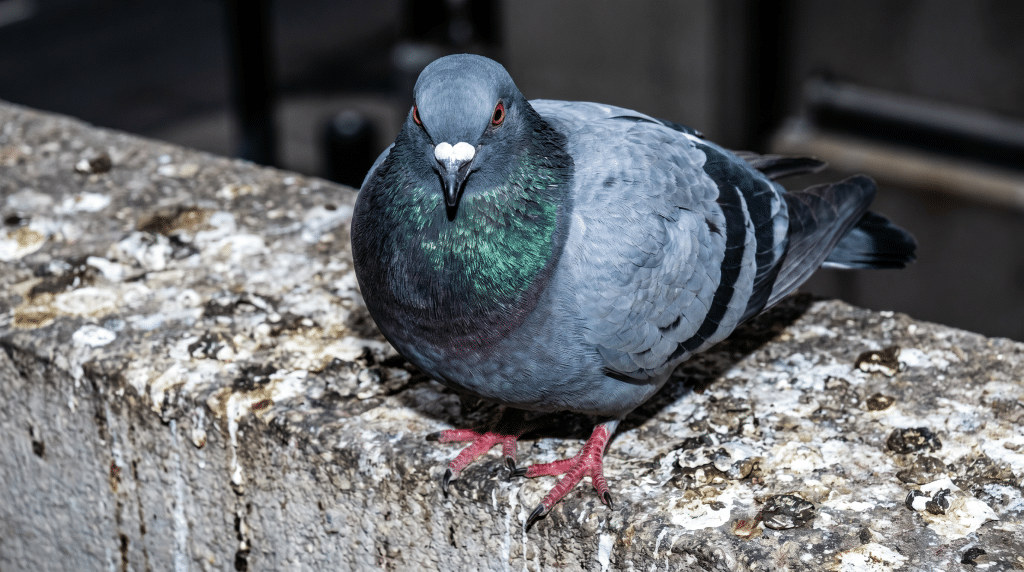

Feral pigeons (Columba livia)
Feral pigeons reign as the most prevalent avian pest across Manchester city centre and across the industrial estates and retail parks that stretch across Manchester area. For instance, Piccadilly Gardens has held a dense, year-round pigeon population for many decades, and from that well-known stronghold the birds have spread outward to commercial rooftops, multi-storey car parks, railway arches, and vast warehouse units scattered right across the region.
An uncontrolled breeding pair produces multiple broods each year, transforming a ledge or roof void roost into a full infestation in two breeding seasons.
Fouling from pigeons from feral pigeons carries a naturally acidic composition that, when left to collect over time, damages roofing membranes and blocks drainage channels, whilst its persistent contact with metal fittings and structural steelwork gradually accelerates corrosion. Critically, feral pigeons hold no protected status under the Wildlife and Countryside Act 1981, meaning pest control treatment and deterrent work can proceed fully without the requirement for a licence. Our pigeon control service here in Tottington encompasses the full selection of exclusion and deterrence methods available.
Gulls (Laridae)
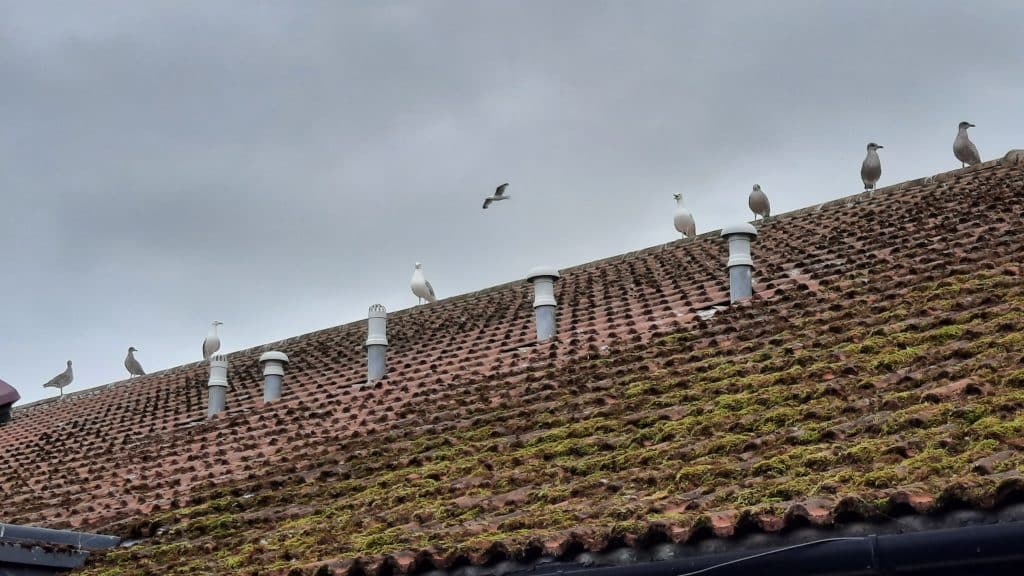
Gull populations have been migrating inland across Tottington for a number of years now. Both the herring gulls and lesser black-backed gulls create nesting colonies on flat commercial rooftops throughout the Tottington area, drawn by food waste generated by restaurants, retail parks, and waste handling sites, as well as the heat that large warehouse rooftops retain during the breeding season.
Whilst nesting, gulls turn increasingly protective and defensive in behaviour, and firmly established gull colonies can make routine roof access truly hazardous for those carrying out maintenance.
Under the 1981 Act, gulls are granted legal protection, meaning that any active nest must stay in place unless a licence has been obtained. Natural England provides general licences, including GL41 which covers public health and safety, authorising licensed pest control companies to undertake certain control activities.
Our service operates fully within the relevant legal framework, guiding on what measures can be taken during the current season whilst identifying the ideal deterrent systems to prevent birds from returning to the very same rooftop next year!
Starlings, sparrows, and corvids
Starling nesting sites lead to fast and severe fouling on commercial buildings throughout autumn and winter across Tottington, and dried starling guano poses the very same risks to health as pigeon droppings!
House sparrows tend to establish their nests within roof voids and beneath loose fascias across housing and industrial buildings throughout the Tottington area. As both species carry full legal protection, the timing of any works and the way taken are of great importance.
Crows, jackdaw birds and magpie birds are corvid species frequently encountered on industrial locations throughout Greater Manchester, and when these birds construct nest sites inside chimneys or flues they introduce a fire hazard that must be addressed outside of the nesting season. We also note pigeons and any additional pest bird species identified during the survey, then structure the management programme in accordance with the legal protections that apply to each individual species.
Bird Control Services Throughout Tottington
Our pest control technicians perform a comprehensive inspection before recommending any bird control solutions. The species of bird being deterred, the site type, and the extent of the infestation all determine the appropriate specification. The majority of commercial projects require a combination of bird control methods rather than a single solution, because pest birds will shift to nearby surfaces once a landing point has been removed. The range of services outlined below comprises everything we deploy across Tottington and the surrounding areas.

Bird netting
Bird netting offers total exclusion across extensive open areas including loading bays, roof voids, canopies and internal courtyards where pigeons nest and perch in substantial numbers. A correctly specified system blocks all bird access and continues a decade with routine inspections. Our pest control technicians hold PASMA and IPAF certifications for safe installation at height on Tottington’s taller commercial and industrial buildings, a capability many local pest control providers plainly cannot match. Pigeon grade and gull grade netting require different mesh apertures, and selecting the wrong gauge allows birds to push through gaps within days of fitting.
Bird spikes
Bird spikes stop pest birds from perching on ledges, parapets, window sills, signage and roof ridges. Picking the right spike specification depends on the breadth of the surface and the species you are targeting: denser, narrower arrays work brilliantly for smaller birds, whilst wider spacing suits pigeons and gulls very well. And here is the really great part! Spikes are an completely humane bird control solution. The blunt tipped prongs simply make surfaces far too uncomfortable to perch or roost on, without causing any harm at all to the birds themselves.
Bird wire and post systems
Tensioned stainless steel wire is strung between discreet, low-profile posts to create an insecure landing surface across wider ledges and stone sills where traditional spikes would prove far too conspicuous. The visual footprint of this system is minimally small when observed from street level, making it the natural choice for high-profile commercial facades and heritage buildings throughout Tottington city centre. Wire systems prove particularly effective as a bird deterrent against gulls, which struggle to rely on a surface that offers no stable foothold beneath them.
Audible and visual bird scarers
Audio bird scarers emit predator calls and distress signals at varying intervals to discourage birds from settling across a site. Visual scarers deploy realistic replicas of birds of prey to make rooftops and ledges feel threatening and unwelcoming. Both forms of bird deterrent system operate most effectively when used in combination with physical exclusion measures, as birds will gradually grow accustomed to a solitary scarer operating on a predictable cycle and will ultimately cease to respond to it altogether.
Falconry
Our hawk handling service employs trained hawks and birds of prey to disperse entrenched pest bird populations from open commercial premises. The introduction of a live bird of prey breaks roosting and nesting patterns more efficiently than static bird control methods across expansive open rooftops and outdoor spaces. Falconry sessions are organised throughout the breeding season and persist until the site no longer continues to function as a roost. The handler records every visit and furnishes written compliance documentation upon request.
Bird nest removal and trapping
Live bird nests are given legal protection under the law under the Wildlife and Countryside Act 1981, though once the nesting season has finished, any existing nests must be cleared away prior to the installation of deterrents. Aged nesting material is known to carry parasites and keep the scent that draws birds back to the very same location, season after season. Our licensed technicians will take out the nest, clean the surrounding area of guano and debris, and install the appropriate deterrent systems all in a single visit. Where pigeon populations are particularly substantial and deterrents alone prove unreliable, a targeted bird trapping programme can bring down numbers to a level at which exclusion measures become effective. Trapping programmes typically run for a period of six to eight weeks.

Bird fouling removal
Accumulated bird guano must be treated as a hazardous material throughout the clearing process. When dried droppings break down, they form a fine dust capable of carrying Salmonellosis and other harmful pathogens, which pose a serious risk if inhaled without adequate respiratory protection. Our bird fouling removal service thoroughly clears and disinfects any affected area before exclusion work is carried out. This pre-cleaning stage is crucial, as it gets rid of the biological scent that would otherwise attract birds directly back through gaps in a newly installed deterrent system.
Why Pest Bird Problems Cost More Than They First Appear
Bird guano has enough acidity to damage a flat roof membrane in a single season alone. The deterioration wrought by an unmanaged bird infestation across a Tottington commercial property passes through drainage systems, structural steelwork, electrical equipment and fire safety infrastructure, generating consequential costs that regularly outweigh the investment required for the bird control work itself.
Structural damage and guano corrosion
Solar panels on commercial premises across Greater Tottington encounter a serious pest threat. Bird droppings and nesting material clog drainage channels, forcing water into the building fabric below. Guano accumulates beneath panel arrays, obstructs drainage, and nesting debris packed around electrical connections or junction boxes creates a fire hazard that most owners only notice during a scheduled maintenance inspection.
Fire risk from nesting materials
Avian nests discovered within roof voids, chimney flues, or in close proximity to electrical wiring pose a genuine fire hazard. Dry nesting material is highly flammable, and nests found near junction boxes or beneath rooftop plant equipment are a regular occurrence across Tottington’s long-standing industrial and commercial properties. Clearing accumulated nesting material during the autumn period between breeding seasons removes this risk well ahead of the coming winter months.
Disease and health risks
Birds are identified vectors of over 60 distinct conditions. Salmonellosis, E. coli, Campylobacter, Psittacosis, Cryptococcosis, and Histoplasmosis are the most often documented diseases associated with pest bird fouling and nesting debris. Histoplasmosis is a fungal infection brought on by airborne spores found in dried droppings, and the associated health risk becomes most acute when guano is disturbed through cleaning operations conducted without appropriate respiratory protection in place.
For food service businesses and leisure operators throughout Tottington, bird presence around loading bays, kitchen vents, or open food storage areas is both a compliance matter and a serious health concern. An environmental health inspection that identifies bird fouling or nesting material in proximity to food production zones can lead to an improvement notice being issued, or a requirement to cease operations whilst remedial work is carried out.
Secondary infestations
Nests of birds and soiling are widely known to attract further pest populations. Bird mites and fleas residing within nesting material will enter a building once the birds have left at the close of the season, whilst the heat and organic matter generated by accumulated guano attracts additional insects. Cleaning the nesting site throughout the course of the programme eliminates this secondary pest risk before it has the opportunity to spread indoors.

Commercial Bird Pest Control Service Across Tottington
Commercial bird pest control in Tottington works with foodservice businesses, hospitality, retail, healthcare, warehousing, and the sprawling industrial and logistics sites across Greater Tottington and into Cheshire. A significant chunk of our commercial work involves working with facilities managers and property teams. Scheduling out of hours? Completely standard practice! Written compliance documentation comes supplied as part of every job, and our technicians operate with complete discretion on customer-facing premises.
Pest Solutions deals with rodent control, insect treatments, wasp nest removal, and commercial pest contracts throughout Tottington, meaning commercial clients facing multiple pest problems can manage absolutely everything via just one pest control company!
Our corporate bird control programmes are founded on integrated pest management (IPM) principles, uniting exclusion, deterrence, and population management into one integrated site-specific strategy. For commercial properties requiring structured oversight, we provide ongoing pest management contracts that encompass scheduled surveys, prompt emergency response between visits, and detailed written reports suitable for environmental health or insurance purposes.
Our bird control programme for commercial sites commences with a no-cost site survey. We determine the most suitable methods for the building in question and schedule installations to work around live operations. Full written records of all work completed are supplied to satisfy compliance and insurance requirements. The programme is structured for long-term management: deterrents are specified to endure for a decade, scheduled inspections are arranged to identify new pressure at the earliest opportunity, and documented evidence of every visit is maintained on file.