


Bird Control Services in Southfields
We employ an extensive range of bird control methods to prevent and exclude pest birds from residential and commercial buildings. The right combination delivers the best results really will depend on the building, the species, and the scale of the problem, and our pest control technicians will always survey the site before recommending a single thing!

Bird spikes and bird wire
Bird spikes and bird wire stand amongst the most commonly employed solutions for deterring birds from settling upon ledges, window sills, parapet walls, and roof ridges. Standard stainless steel spikes are designed to cover flat ledge surfaces, preventing birds from roosting whilst causing absolutely no harm whatsoever to them.

Bird wire systems work by securing steel springs and wires between supports or anchor points across ledges and structural surfaces, creating an unstable landing zone that prevents birds from perching. Once properly installed, both systems are engineered to endure harsh weather conditions with low ongoing maintenance required.
Bird netting in Southfields
Bird netting serves as a highly effective exclusion method, sealing off expansive areas such as roof voids, loading bays, the underside of canopies and bridges, and open courtyards. When specified correctly, it prevents birds from nesting and roosting within a given space altogether.

Pigeon netting and gull grade netting are produced with varied mesh sizes in order to meet the specific requirements of each bird species. Our pest control technicians will assess the appropriate mesh gauge, fixing system and support structure for your individual site, as netting that has been installed with an incorrect gauge will let birds to pass through the gaps straight away.
Falconry and birds of prey
Falconry services employ expertly trained hawks and multiple other birds of prey to encourage pest birds away from a specific location. The inherent presence of these predatory birds alters established roosting behaviours and causes pest birds in urban settings to vacate the site altogether.
Regular falconry visits are scheduled all the way through and beyond the breeding season, continuing on until the site is no longer being used as a roost.
Using hawks as a reliable and humane bird deterrent works most effectively across expansive environments such as vehicle parks, stadiums, retail parks, and large rooftops. Regular falconry visits are scheduled all the way through and beyond the breeding season, with the programme carrying on until the site is no longer being used as a roosting location.
Solar panel bird proofing
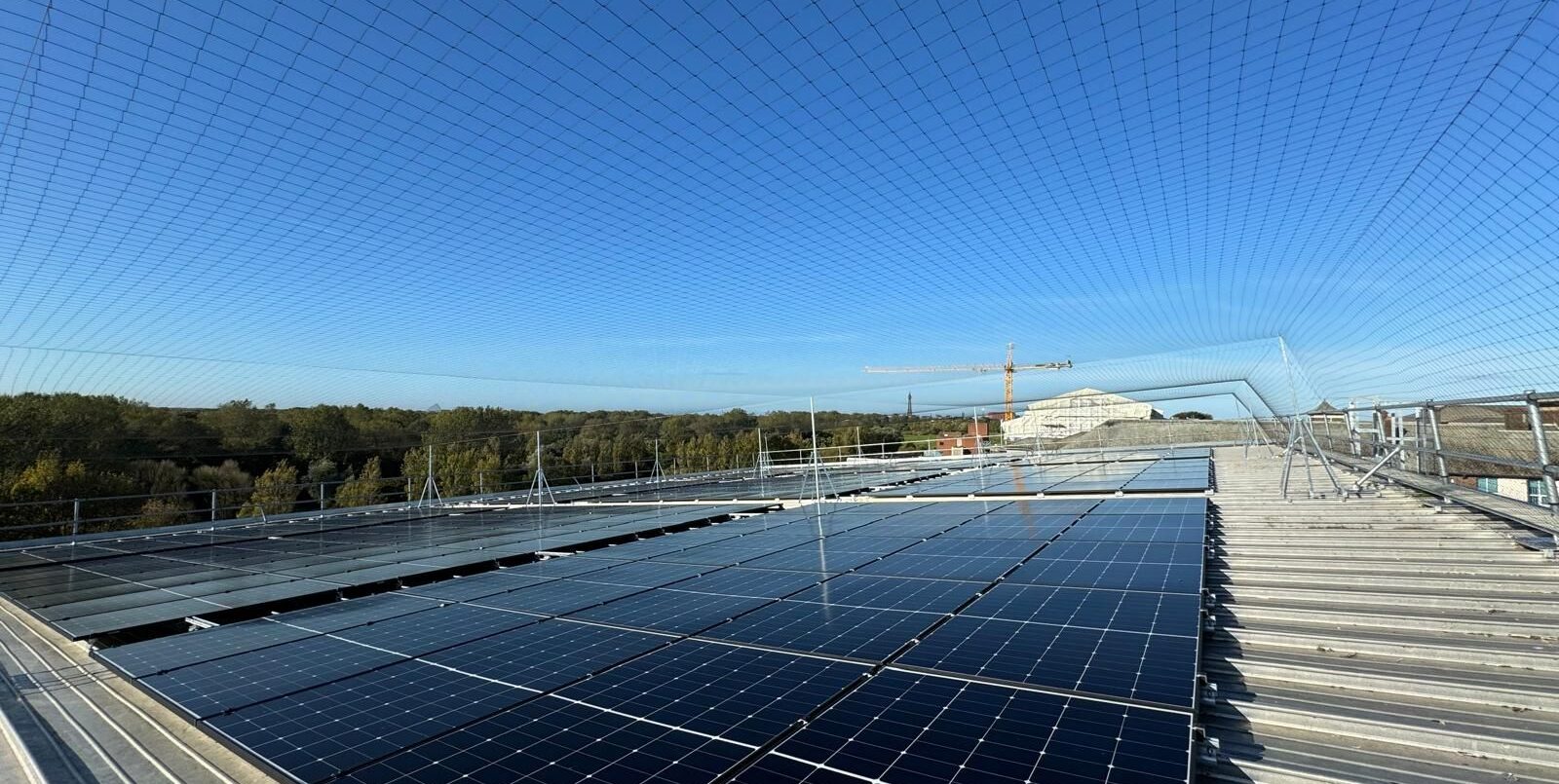
PV panels are a typical cause of pigeon-related issues across Southfields. The gap that lies between the panels and the roof tiles offers birds a protected and cosy environment during all season{s}, and when pigeons nest beneath them, the resulting bird guano can lead to water damage, blocked gutters and drains, and the steady deterioration of roofing materials.

Solar panel bird proofing uses mesh and clip systems around the panel perimeter to seal the gap. The clip system attaches around the panel frame without affecting the panels or impacting output, and the mesh stops birds from nesting beneath panels whilst stopping the problem from happening again each season.
Pest Bird Species in Southfields
Feral pigeons and gulls are account for the bulk of bird pest enquiries received throughout Southfields, though starlings, sparrows, and a range of additional bird species contribute significantly to fouling, noise disturbance, and structural deterioration on properties across the area. Pigeons are a species against which proofing measures can be implemented immediately. Gulls, however, carry legal protection, and the appropriate course of action will differ greatly depending on whether nesting activity is already in progress on the affected property.
Feral pigeons in Southfields
Feral pigeons constitute the most frequently encountered avian pest species found across Southfields. They form roosting and nesting sites upon ledges, fire escapes, rooftops and bridge structures throughout the area, generating large quantities of bird droppings that present simultaneously a public health and safety concern and repeated maintenance expenditure for those responsible for managing properties.

Feral pigeon guano is considerably acidic in nature and actively hastens the corrosion of both metal structures and stonework over time. The droppings themselves are known carriers of salmonella and a range of other dangerous pathogens, and RSPH guidance firmly identifies bird waste as a serious public health risk for any commercial premises where birds are found to be active above food storage or preparation areas.
Gulls and seagulls in Southfields
Seagulls have been establishing nesting colonies on Southfields’s rooftops for a number of decades and have, over that time, grown considerably accustomed to human presence outside of the breeding season. Once eggs have been laid, routine access to the roof becomes unworkable, outdoor spaces situated directly beneath the nest become difficult to use, and both the swooping behaviour and persistent calling become noticeably more intense until the chicks reach fledging age in late summer.
Pigeons and gulls regularly frequent the same roofs, yet controlling gulls presents a considerably greater challenge. They are larger and more long-lived creatures that return year after year to the same nesting site year upon year, and they have the full legal protection of the law under the Wildlife and Countryside Act 1981.
Disturbing a gull nest or collecting its eggs without the appropriate licence is prohibited under current legislation. Our team operates fully within the relevant legal framework governing pest management in relation to protected species, offering practical guidance on the actions that may be taken without delay alongside those that will require a formal licence application, supported by documented evidence of public health or safety concerns.
Bird Proofing for Southfields Properties
Safeguarding a Southfields property from pest birds necessitates a thoughtful solution that is entirely appropriate for the building in question. Bird spikes work very well on narrow ledges yet struggle to provide adequate coverage across wider surfaces, whilst netting that has been inappropriately specified for either the species or the structure will allow birds immediate access through any gaps that remain.
Our pest control technicians conduct a detailed site assessment prior to proposing a solution. The survey includes the entire building rather than just the most visible roosting areas, as birds will relocate to neighbouring surfaces once the most appealing ones have been treated.
Our bird control methods operate through preventing entry and deterrence, stopping birds from nesting on roof spaces and overhangs. We support clients on the best-suited solution for the species involved, taking into account all relevant legal protections, and every measure we carry out is both successful and non-harmful.
Kind bird control gives priority to physical exclusion as its main method, with pigeon proofing and deterrence meeting the vast majority of residential and commercial requirements without any need for licensed lethal intervention.
We also provide pest management contracts for Southfields properties, covering scheduled inspections, compliance reports for environmental health purposes, and a rapid response service should any fresh bird activity be identified between visits.
