


Bird Control Services in Sleaford
We apply a variety of bird control methods to exclude pest birds from both residential and industrial buildings, and the most effective combination depends entirely upon the building itself, the species involved, and the severity of the infestation, which is why our pest control technicians undertake a careful site survey before providing any recommendations whatsoever.

Bird spikes and bird wire
Bird spikes and bird wire rank amongst the most widely used solutions for deterring birds from settling on ledges, window sills, parapet walls, and roof ridges. Traditional stainless steel spikes are designed to cover flat ledge surfaces, preventing birds from roosting whilst ensuring they remain completely unharmed.

Bird wire systems work by attaching steel springs and wires between pillars or anchor points extended across a ledge or structural surface. This creates an unstable landing zone that birds simply cannot stand! Both systems hold up brilliantly against harsh weather conditions and demand no regular maintenance once correctly fitted. How great is that?
Bird netting in Sleaford
Bird netting is a highly effective exclusion method, blocking off expansive areas such as roof cavities, loading areas, spaces beneath canopies and bridges, and open courtyards. When correctly specified, netting prevents birds from nesting and roosting within a given space altogether.

Pigeon netting and gull grade netting use various mesh sizes to address each species. Our pest control technicians select the mesh gauge, fixing system and support structure for the site because netting installed with the wrong gauge allows birds access through gaps straight away.
Falconry and birds of prey
The use of specially trained hawks and other birds of prey in falconry services helps to scatter pest birds from a particular location. When a bird of prey is released to the area, it naturally disrupts any established roosting behaviour, encouraging pest birds in urban settings to leave the site entirely.
Regular falconry visits are scheduled all the way through and beyond the breeding season, continuing on until the site is no longer being used as a roost.
Using hawks as a consistent and humane bird deterrent works most effectively across wide-open environments such as parking lots, stadiums, retail parks, and large rooftops. Regular falconry visits are scheduled throughout and beyond the breeding season, with the programme continuing on until the site is no longer being used as a roosting location.
Solar panel bird proofing
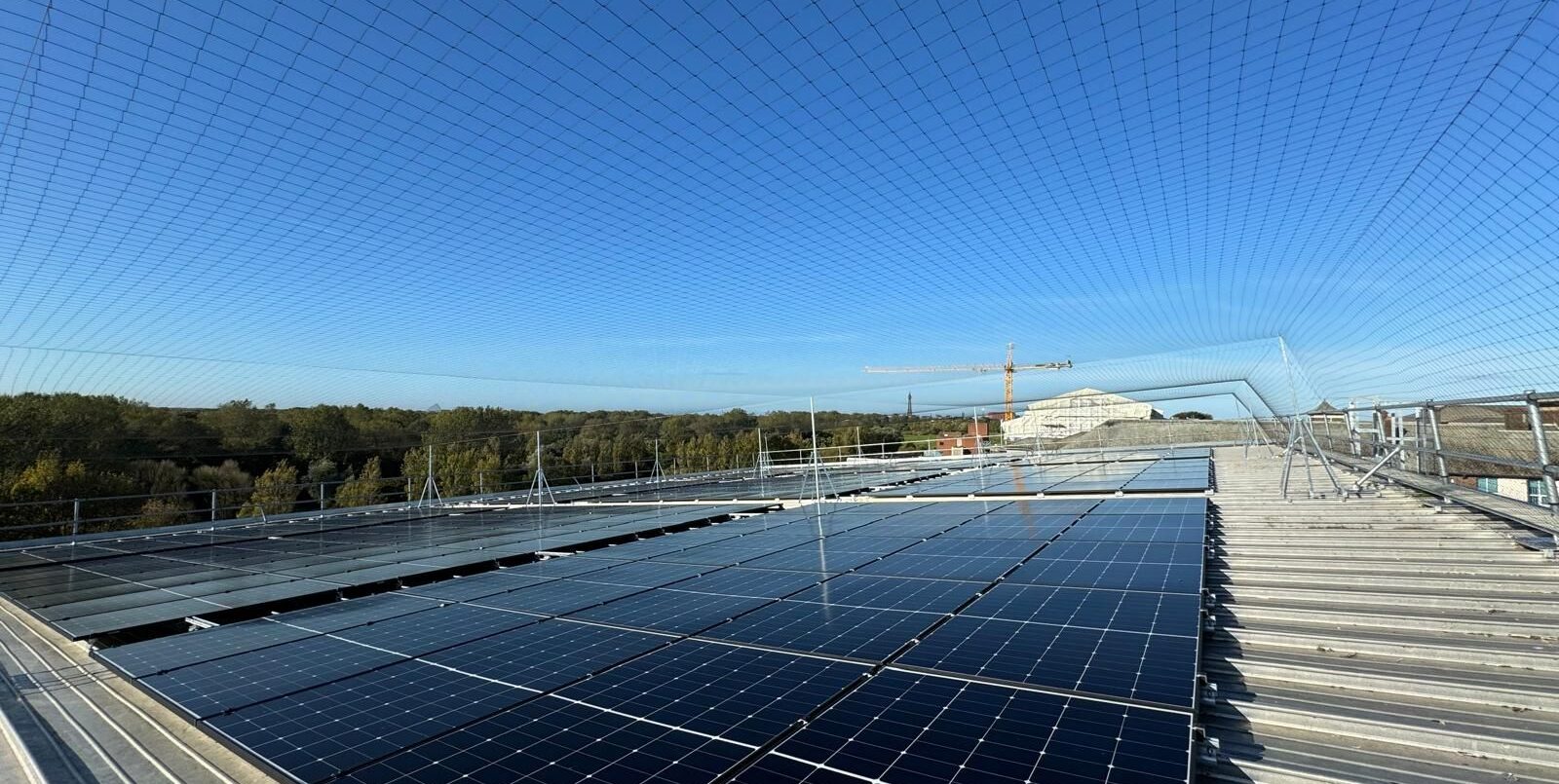
Solar panels stand as one of the most typical causes for pigeon-related disturbances across Sleaford, where the inviting gap between the panels and the roof tiles offers birds a protected nesting place throughout every season. The breeding activity that follows tells a well-known and damaging story, one written in bird guano that slowly wreaks havoc on rooftops, clogging gutters and drains whilst steadily degrading the very materials that keep a building protected over time.

Solar panel bird proofing fits mesh and clip systems around the panel edges to protect the gap. The clip system fixes around the panel frame without damaging the panels or reducing output, and the mesh keeps birds from nesting beneath panels whilst avoiding the problem from recurring each season.
Pest Bird Species in Sleaford
{Feral pigeons and gulls are behind the overwhelming majority of bird pest enquiries logged across Sleaford, though starlings, sparrows, and a range of other species are equally capable of causing fouling, noise, and structural damage to properties throughout the area. Pigeons are ideal for immediate proofing solutions. Gulls, however, are afforded legal protection and therefore require a carefully considered course of action that is shaped entirely by whether or not nesting activity is already underway.}
Feral pigeons in Sleaford
Feral pigeons represent the most frequently encountered avian pest species found across Sleaford. They create roosting and nesting sites upon ledges, fire escapes, rooftops and bridge structures throughout the area, generating considerable quantities of bird droppings that present both a public health and safety concern and substantial maintenance expenditure for those responsible for managing properties.

Feral pigeon guano is very acidic in nature and actively speeds up the corrosion of both metal structures and stonework over time. The droppings themselves are known carriers of salmonella and a variety of other dangerous pathogens, and RSPH guidance firmly identifies bird waste as a substantial public health risk for any commercial premises where birds are found to be present above food storage or preparation areas.
Gulls and seagulls in Sleaford
Gulls have been setting up nests on Sleaford buildings for several decades and have, for the most part, lost their natural caution around people outside of the breeding season. Once eggs have been laid, routine access to the roof must stop, outdoor spaces situated directly beneath the nest become difficult to use, and the diving behaviour along with continuous calling grows steadily intense until the chicks fledge towards the end of summer.
Pigeons and seagulls commonly use the same rooftops, yet dealing with gull populations brings a considerably more substantial challenge. Gulls are larger and longer-lived birds that reliably revert to exact nesting locations season after season, and they are afforded full legal protection under the Wildlife and Countryside Act 1981.
Our team work carefully within the law governing pest management around protected species, informing on what action can be taken immediately and what will require a formal licence application supported by evidenced health and safety grounds. Please be aware that removing a gull nest or eggs without a licence is not something that is legally permitted under any circumstances.
Bird Proofing for Sleaford Properties
Protecting a Sleaford property from pest birds depends entirely on picking the best-fitting solution for the specific building in question. Whilst bird spikes are effective on narrow ledges, they are less effective across wider surfaces where gaps remain, and netting that has been incorrectly specified for either the bird species or the structural context will provide access points almost immediately.
Our pest control technicians conduct a full site survey before suggesting any system. The survey covers the entire building, not just the obvious roost points, because birds will relocate to nearby surfaces once the most attractive ones are treated.
Our bird control methods function through exclusion and deterrence, preventing birds from nesting on roof areas and overhangs. We guide clients on the most appropriate solution for the species involved, bearing in mind all relevant legal protections, and every measure we carry out is both efficient and kind.
Non-lethal bird control depends on barrier methods as its chief method, with pigeon proofing and deterrence dealing with the vast majority of residential and commercial work without any requirement for licensed lethal intervention.
We also provide pest management contracts for Sleaford properties that cover scheduled inspections, compliance documentation for environmental health purposes, and rapid response between visits should any fresh bird activity be identified.
