


Bird Control Manchester Experts on Common Local Pest Bird Species
The different pest species found across Crumpsall each demand their own carefully considered strategy. Which bird species is present determines the legal standing, the chosen method of control, and the timeframe within which the work must be carried out. What follows outlines the situations our bird control team encounters most frequently across Manchester.
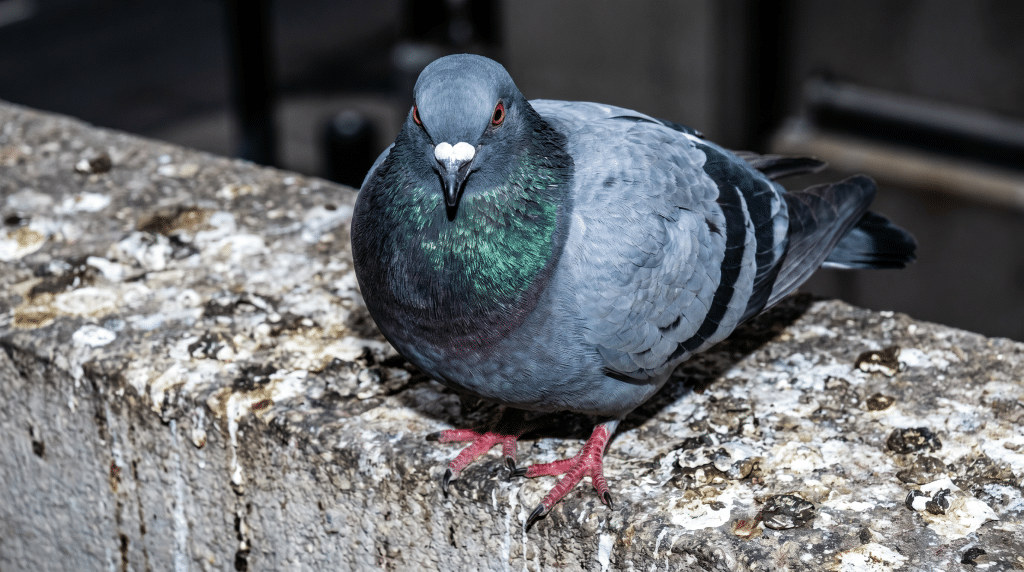

Feral pigeons (Columba livia)
Feral pigeons represent the most prevalent avian pest challenge in Crumpsall city centre, as well as throughout the industrial estates and retail parks extending across Manchester. For example, Piccadilly Gardens has supported a dense, year-round pigeon population for decades, and from this established hub the birds have expanded their presence to commercial rooftops, multi-storey car parks, railway arches, and large warehouse units throughout the wider region.
An uncontrolled breeding pair yields numerous broods every year, making a ledge or roof void roost into a full infestation within two breeding seasons.
Fouling from birds from feral pigeons is very acidic in nature. When permitted to build up, it causes serious damage to roofing membranes and blocks drainage channels, and where it comes into contact with metal fittings and structural steelwork it speeds up corrosion substantially over time. Feral pigeons carry no protection under the Wildlife and Countryside Act 1981, meaning pest control treatment and deterrent work can go ahead without the need for a licence. Our pigeon control service covers the complete range of exclusion and deterrence methods available!
Gulls (Laridae)
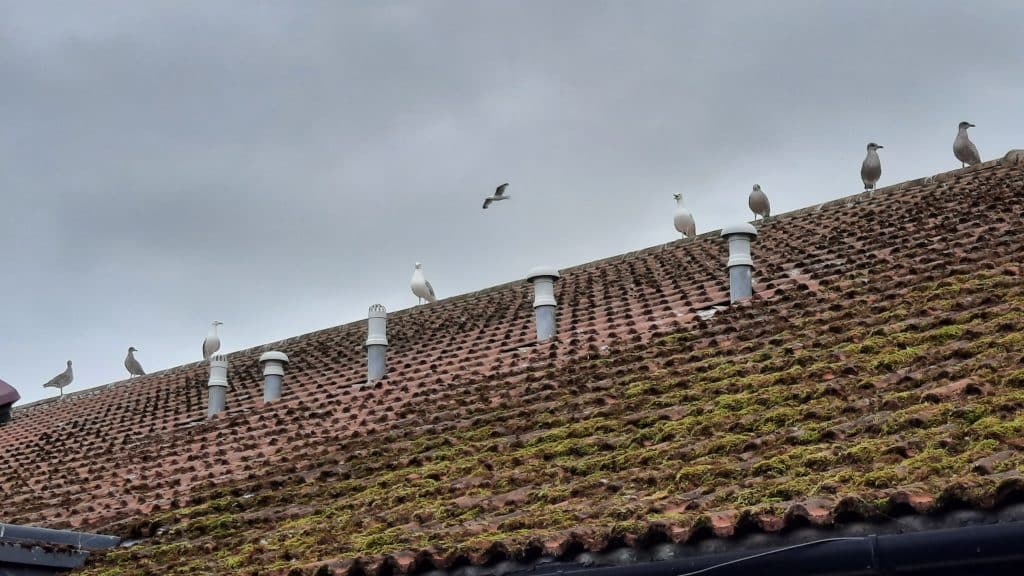
Gull populations have been spreading inland across Crumpsall for a number of years recently. Both the herring gulls and lesser black-backed gulls form nesting colonies on flat commercial rooftops throughout the Crumpsall area, drawn by food waste generated by restaurants, retail parks, and waste handling sites, as well as the warmth that large warehouse rooftops retain during the breeding season.
Nesting gulls grow fiercely guarded and territorial, and mature gull colonies can turn routine rooftop access into a genuinely risky experience for maintenance personnel.
Seagulls are protected under the Wildlife and Countryside Act 1981, meaning active nests cannot be disturbed without a licence. Natural England provides general licences, including GL41 for public health and safety, permitting approved pest control companies to carry out certain control activities.
Our service operates entirely within the boundaries of the relevant legal framework, informing clients on the lawful courses of action open during the current season whilst setting out appropriate deterrent systems to prevent birds from returning to the same rooftop in the next year that follows.
Starlings, sparrows, and corvids
Starlings roosts create quick and substantial fouling across commercial buildings during the autumn and winter months in Crumpsall, and once dried, starling guano poses an equivalent health hazard to that posed by pigeon droppings.
House house sparrows are understood to build their nest sites within roof voids and beneath unfixed fascias across housing and business buildings throughout the Crumpsall area. As both species carry full legal protection, the scheduling of any works and the method taken are of substantial importance.
Carrion crows, rooks, and jackdaws are corvids frequently encountered on industrial sites throughout Greater Manchester, and when these birds make nests within chimneys or flues, they create a genuine fire hazard that must be addressed outside of the nesting season. We identify pigeons and all other bird pest species present during the survey and prepare the programme in accordance with the legal protections afforded to each individual species.
Bird Control Services Throughout Crumpsall
Our pest management technicians carry out a thorough inspection before proposing any bird control solutions whatsoever. The type of species involved, the building type, and the scale of the infestation all influence the final specification. Most commercial jobs call for a combination of bird control methods rather than one single solution, because pest birds simply relocate to nearby surfaces once a landing point is removed. The range of services below covers everything we deploy across Crumpsall and the surrounding areas!

Bird netting
Bird netting delivers total exclusion across large open spaces: loading bays, roof voids, canopies, and internal courtyards where pigeons nest and roost in serious numbers. A correctly specified netting system blocks every bird access fully and holds up for a ten years with routine inspections. Our pest control technicians carry PASMA and IPAF certifications for safe working at height on Crumpsall’s larger commercial and industrial buildings, something many local pest control providers simply cannot offer. Pigeon grade and gull grade netting require distinct mesh apertures, and selecting the wrong gauge lets birds find gaps and squeeze through within a matter of days of installation!
Bird spikes
Spikes prevent pest birds from settling on ledges, parapets, window sills, signage, and roof ridges. The correct spike specification depends on the surface width and the target species: more compact, tighter sets suit smaller birds, whilst wider spacing is effective for pigeons and gulls. Spikes are a humane bird control solution. The blunt-tipped prongs make surfaces too uncomfortable to land or roost on without causing harm to the birds.
Bird wire and post systems
Bird wire systems work by running tensioned stainless steel wire between subtle low-profile posts, forming an unsteady landing surface across larger ledges and stone sills where spike systems would appear too noticeable. The installation carries minimal visual weight when observed from street level, making it the most suitable solution for prominent commercial frontages and heritage buildings throughout Crumpsall city centre. Wire systems prove particularly effective as a bird deterrent against gulls in particular, as these birds struggle to gain proper use from an unstable surface beneath them.
Audible and visual bird scarers
Audible bird scarers emit predator calls and distress signals at irregular intervals to prevent birds from settling on site. Visual scarers deploy bird of prey replicas to make rooftops and ledges feel unsafe. Both deterrent types are most effective when used alongside with physical exclusion measures, as birds grow accustomed to a single scarer operating on a set cycle and cease responding to it.
Falconry
Our falconry visits dispatches trained hawks and birds of prey out to disperse established pest bird populations from open commercial sites. The presence of a live bird of prey disturbs roosting and nesting behaviour far more effectively than static bird control measures across wide open rooftops and outdoor areas. Falconry visits are closely scheduled throughout the breeding season and continue until the site is no longer being used as a roost. The handler notes every single visit and provides written compliance records if requested.
Bird nest removal and trapping
Active bird nests are safeguarded by the Wildlife and Countryside Act 1981, though once the nesting season is over, any remaining nests must be cleared before deterrent measures can be installed. Previous nesting material is a haven for parasites and carries the lingering scent that draws birds to return to the very same spot season after season. Our licensed technicians will remove the nest, fully clean the area of guano and debris, and fit the appropriate deterrent systems all within a single visit. Where pigeon populations prove too large for deterrents alone to manage effectively, a carefully targeted bird trapping programme can reduce their numbers sufficiently for exclusion measures to take hold. Trapping programmes typically run for a period of between six and eight weeks.

Bird fouling removal
Built-up bird guano calls for treatment as a hazardous material at the point of removal. Dried droppings disintegrate into an airborne dust capable of carrying Salmonellosis and other dangerous pathogens when inhaled by those cleaning without proper respiratory protection. Our bird fouling removal service fully clears and disinfects every affected area before any exclusion work commences. This essential pre-cleaning stage eliminates the biological scent that would otherwise draw birds straight back through gaps in a freshly installed deterrent system.
Why Pest Bird Problems Cost More Than They First Appear
Bird guano is acidic enough to damage a flat roof membrane in one season! The damage caused by an uncontrolled bird infestation on a Crumpsall commercial property affects drainage systems, structural steelwork, electrical equipment and fire safety provisions, with associated costs that often outweigh the bird control work itself.
Structural damage and guano corrosion
Solar panels installed across commercial buildings throughout Greater Crumpsall are facing a highly real and increasing pest problem! Bird droppings and nesting material accumulate beneath panel arrays, clogging drainage channels and forcing water back into the building fabric below. And that is not by any means the most alarming part. Nesting material packed tightly against electrical connections and junction boxes creates a genuine fire hazard, one that most property owners only discover when a maintenance inspection at last takes place. Guano builds up fast and the consequences of ignoring it can be serious!
Fire risk from nesting materials
Avian nests in roof voids, chimney flues, or near electrical wiring present a genuine fire hazard. Dried nesting material sets alight easily, and nests close to junction boxes or beneath rooftop plant equipment are a frequent find across Crumpsall’s older industrial and commercial buildings. Clearing nesting material during the autumn gap between breeding seasons eliminates the risk ahead of the following winter.
Disease and health risks
Birds can spread over 60 diseases. Salmonellosis, E. coli, Campylobacter, Psittacosis, Cryptococcosis and Histoplasmosis is amongst the most often identified in relation to pest bird fouling and nesting material. Histoplasmosis is an infection caused by fungi triggered by spores present in dried droppings, and the risk increases when guano is disturbed during cleaning without adequate respiratory protection.
For food businesses and hospitality operators throughout Crumpsall, bird activity around loading areas, kitchen extractor vents, or open food storage areas constitutes both a compliance matter and a serious health concern. An environmental health inspection that identifies active fouling or nesting material in proximity to food production zones can lead to an improvement notice being issued, or a requirement to cease operations whilst remedial work is carried out.
Secondary infestations
Bird nests and fouling are magnets for secondary insect populations! The fleas and bird mites harbouring in nesting material will move into the building once the birds have gone at the end of the season, and the warmth plus organic matter from a guano build-up draws in many different other insects. Cleaning the nesting site during the programme removes this secondary insect risk before it ever gets the chance to migrate inside!

Commercial Bird Pest Control Service Across Crumpsall
Business bird pest control in Crumpsall supports food businesses, hospitality, retail sites, healthcare facilities, warehousing, and the large industrial and logistics sites across Greater Crumpsall and into Cheshire. Most of our commercial work is undertaken in close collaboration with facilities managers and property teams. Scheduling outside of standard business hours is a routine part of our service. Written compliance documentation is provided as a matter of course, and our technicians operate with full discretion on customer-facing premises.
Pest Solutions manages rodent control, insect treatments, wasp nest removal and commercial pest contracts throughout Crumpsall, meaning commercial clients managing various pest challenges can arrange everything seamlessly through one specialist pest control company.
Our business bird control programmes are based on integrated pest management principles, merging exclusion, deterrence and population management into one cohesive location-specific strategy. This thorough approach ensures that every aspect of bird-related risk is covered within a single cohesive framework tailored to the individual property. We deliver ongoing pest management contracts for commercial premises requiring scheduled inspections, swift emergency response between planned visits, and formal written documentation suitable for environmental health or insurance purposes.
Our commercial bird control programme commences with a free site survey. We assess the best-suited methods for the building and schedule all installations around your live operations. Written records of every task completed are supplied for compliance and insurance purposes. The programme is designed for long term control, with deterrents specified to serve for a decade, scheduled inspections to identify new pressure early, and written evidence of every visit kept on file.