


Bird Control Services in Chilton
We use a variety of bird control methods to keep and remove pest birds from both residential and commercial properties. The most suitable mix will depend upon the building itself, the species involved, and the extent of the infestation, which is why our pest control technicians conduct a comprehensive site survey before making any recommendations.

Bird spikes and bird wire
Bird spikes and bird wire rank among the most commonly chosen systems out there for keeping birds away from ledges, window sills, parapet walls, and roof ridges! Standard stainless steel spikes work very effectively across flat ledge surfaces, stopping birds from roosting whilst causing absolutely no harm whatsoever.

Steel springs and wires are attached between pillars or anchor points across ledges and structural surfaces to form bird wire systems. The wire forms an unsteady landing zone that birds will not use. Once accurately installed, both systems endure harsh weather conditions without requiring frequent maintenance.
Bird netting in Chilton
Bird netting serves as a highly effective exclusion method, intended to close off large areas such as roof voids, loading bays, beneath canopies and bridges, and open courtyards. When specified correctly, netting prevents birds from accessing a space to nest or roost altogether.

Pigeon netting and gull grade netting are manufactured with different mesh sizes, each one specifically designed to target each species. Our pest control technicians determine the correct mesh gauge, fixing system and support structure for every individual site, because netting installed with the wrong gauge will allow birds access through the gaps almost immediately!
Falconry and birds of prey
Falconry services utilise trained hawks and other birds of prey to chase pest birds away from a site. A bird of prey’s presence shatters established roosting patterns and drives birds in urban environments off the site completely.
Regular employment of hawks as a humane bird deterrent has proven most effective across unenclosed locations such as car parks, stadiums, retail parks and large rooftops. Falconry visits are arranged on a set basis throughout and beyond the breeding season, with the programme staying active until the site no longer operates as a roosting area.
Solar panel bird proofing
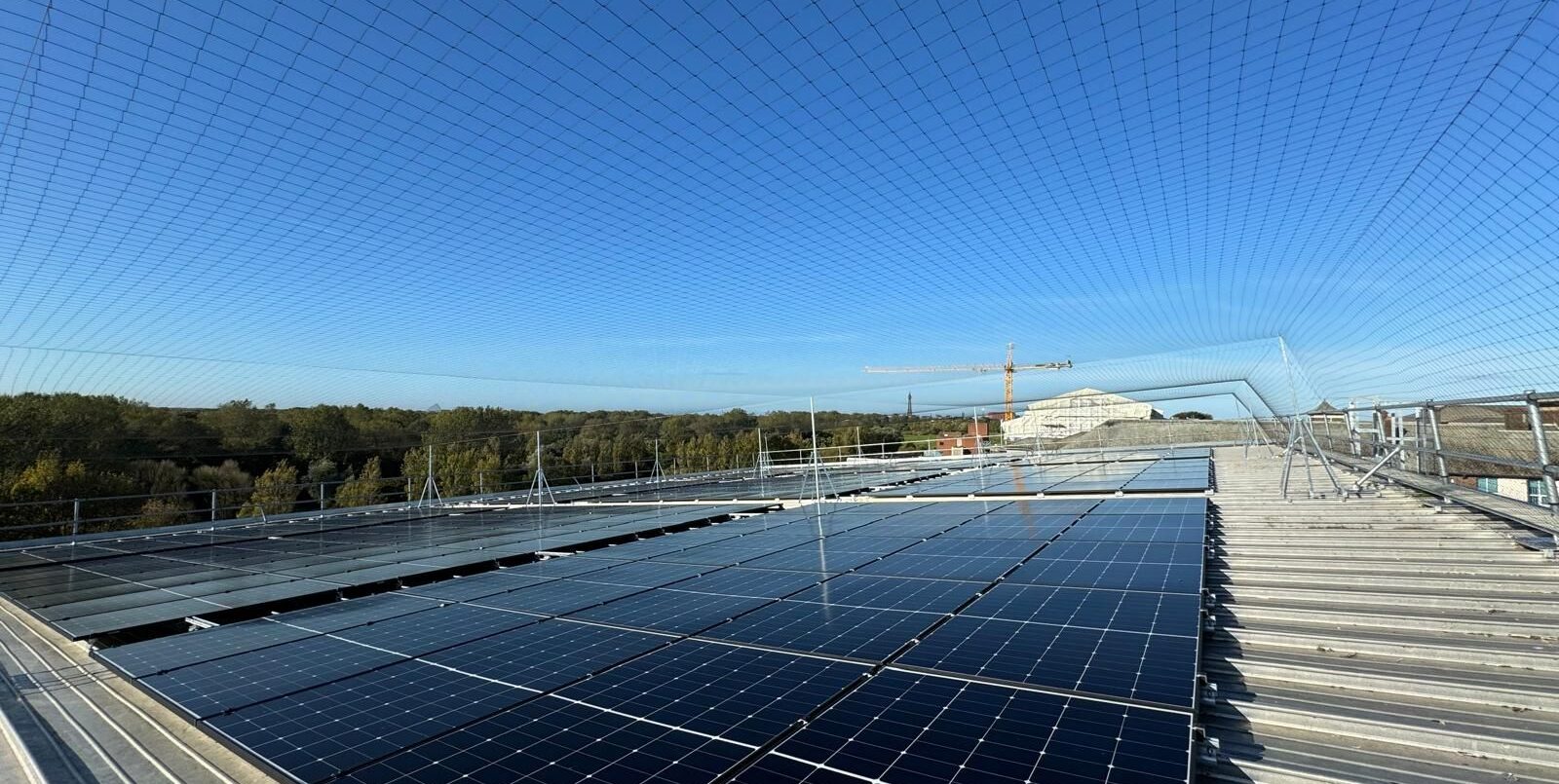
Solar panel systems are one of the most frequent sources of pigeon-related challenges across Chilton. The gap that exists between the panels themselves and the underlying roof tiles provides a protected, temperate environment that stays welcoming throughout every season, attracting birds to roost beneath them. The resulting accumulation of bird guano results in water damage, obstructs gutters and drainage systems, and gradually deteriorates roofing materials over time.

PV panel bird proofing involves installing mesh and clip systems around the panel perimeter to block the gap. The clip system fastens around the panel frame without penetrating the panels or compromising their output, and the mesh installation prevents birds from nesting beneath the panels whilst stopping the problem from recurring each season.
Pest Bird Species in Chilton
Feral pigeons and gulls are account for the majority of bird pest call outs across Chilton, though starlings, sparrows and an array of other species are equally capable of causing fouling, noise and structural damage to properties throughout the area. Pigeons? They can be excluded against right away! Gulls are another matter entirely though, as they are protected by law, meaning the approach taken will differ depending on whether or not nesting is already underway.
Feral pigeons in Chilton
Feral pigeons are Chilton’s most widespread pest bird. They occupy ledges, fire escapes, rooftops and bridge structures throughout the area, producing substantial volumes of droppings that bring public health and safety risks whilst creating considerable ongoing maintenance costs for property managers.

Guano from feral pigeons produced by feral pigeons is inherently acidic in nature and actively accelerates the deterioration of both metalwork and stonework through corrosion. The droppings themselves are capable of harbouring salmonella alongside a range of other hazardous pathogens, and guidance issued by the RSPH clearly identifies bird waste as a significant public health concern for commercial premises, particularly in instances where birds are frequenting areas situated above food storage or preparation zones.
Gulls and seagulls in Chilton
Gulls have been building nests on Chilton buildings for several decades and have, for the most part, lost their natural caution around people outside of the breeding season. Once eggs have been laid, day-to-day access to the roof must come to an end, outdoor spaces situated directly beneath the nest become awkward to use, and the diving behaviour along with persistent calling grows increasingly intense until the chicks leave the nest towards the end of summer.
Pigeons and seagulls frequently occupy the same rooftops, yet addressing gulls presents a much greater challenge. Gulls are larger, more long-lived birds that habitually return to the very same nesting site from one year to the next, and they benefit from full legal protection under the Wildlife and Countryside Act 1981.
Our team works within the legal framework for dealing with protected species, guiding on prompt actions and licence applications supported by documented public health or safety grounds. Interfering with a gull nest or eggs without a licence is not legally permitted.
Bird Proofing for Chilton Properties
Safeguarding a Chilton property against pest birds demands careful selection of the optimal deterrent method for the particular building in question. Bird spikes operate dependably on narrow ledges, yet they fail to provide adequate coverage across wider surfaces, whilst netting that has been poorly specified for either the bird species or the structure will afford birds immediate access through the resulting gaps.
Our pest control technicians complete a full site survey before recommending any system. The survey covers the entire building, not just the obvious roost points, because birds will shift to nearby surfaces once the most attractive ones are treated.
Our bird control methods implement exclusion and deterrence techniques to deter birds nesting on roofs and ledges. We advise clients on the most suitable approach for each species, accounting for all relevant legal protections, and every solution we deliver is both practical and ethical.
Non-lethal bird control is based on preventative exclusion as its chief method, with pigeon proofing and deterrence handling the great bulk of residential and commercial work without any requirement for licensed lethal intervention.
We also provide pest management contracts for Chilton properties, covering scheduled inspections, compliance reports for environmental health purposes, and a rapid response service should any fresh bird activity be identified between visits.
