


Bird Control Services in Canary Wharf
We employ a comprehensive range of bird control methods to deter and exclude pest birds from residential and commercial buildings. The best combination works best really depends on the building, the species, and the scale of the problem, and our pest control technicians will always inspect the site before suggesting a single thing!

Bird spikes and bird wire
Bird spikes and bird wire are two of the most widely adopted systems for deterring birds from landing on ledges, window sills, parapet walls and roof ridges. Standard stainless steel spikes are designed to protect flat ledge surfaces, preventing birds from roosting without inflicting them any harm.

Avian wire systems work through a network of steel spring coils and wires that are taut between pillars or anchor points along ledges and structural surfaces. This arrangement generates an unstable landing zone that birds instinctively steer clear of. Once correctly installed, both systems are highly hard-wearing to harsh weather conditions and require no regular servicing thereafter.
Bird netting in Canary Wharf
Bird netting provides a very effective exclusion measure, sealing off large areas such as roof cavities, loading docks, areas under canopies and bridges, and open outdoor courtyards. When correctly designed, netting prevents birds from nesting and roosting within a given space completely.

Pigeon netting and gull grade netting are manufactured with differing mesh sizes precisely because each species demands a tailored approach. Our pest control technicians carefully determine the appropriate mesh gauge, fixing system and support structure for every individual site, given that netting installed with an incorrect gauge will grant birds access through the gaps almost immediately after installation.
Falconry and birds of prey
Falconry services employ trained falcons and other birds of prey to scare pest birds away from a site. The presence of a hunting bird totally breaks up existing roosting patterns and prompts birds in urban environments to leave the site entirely!
Routine falconry visits are arranged during and beyond the breeding season, proceeding right up until the site has been fully vacated as a roost by the birds.
Utilising hawks as a consistent and humane bird deterrent is most effective across open environments such as car parks, stadiums, retail parks and expansive rooftops, where the natural presence of a predator makes the biggest impression. Regular falconry visits are scheduled throughout and beyond the breeding season, continuing faithfully until the site has been fully abandoned as a roost by the birds.
Solar panel bird proofing
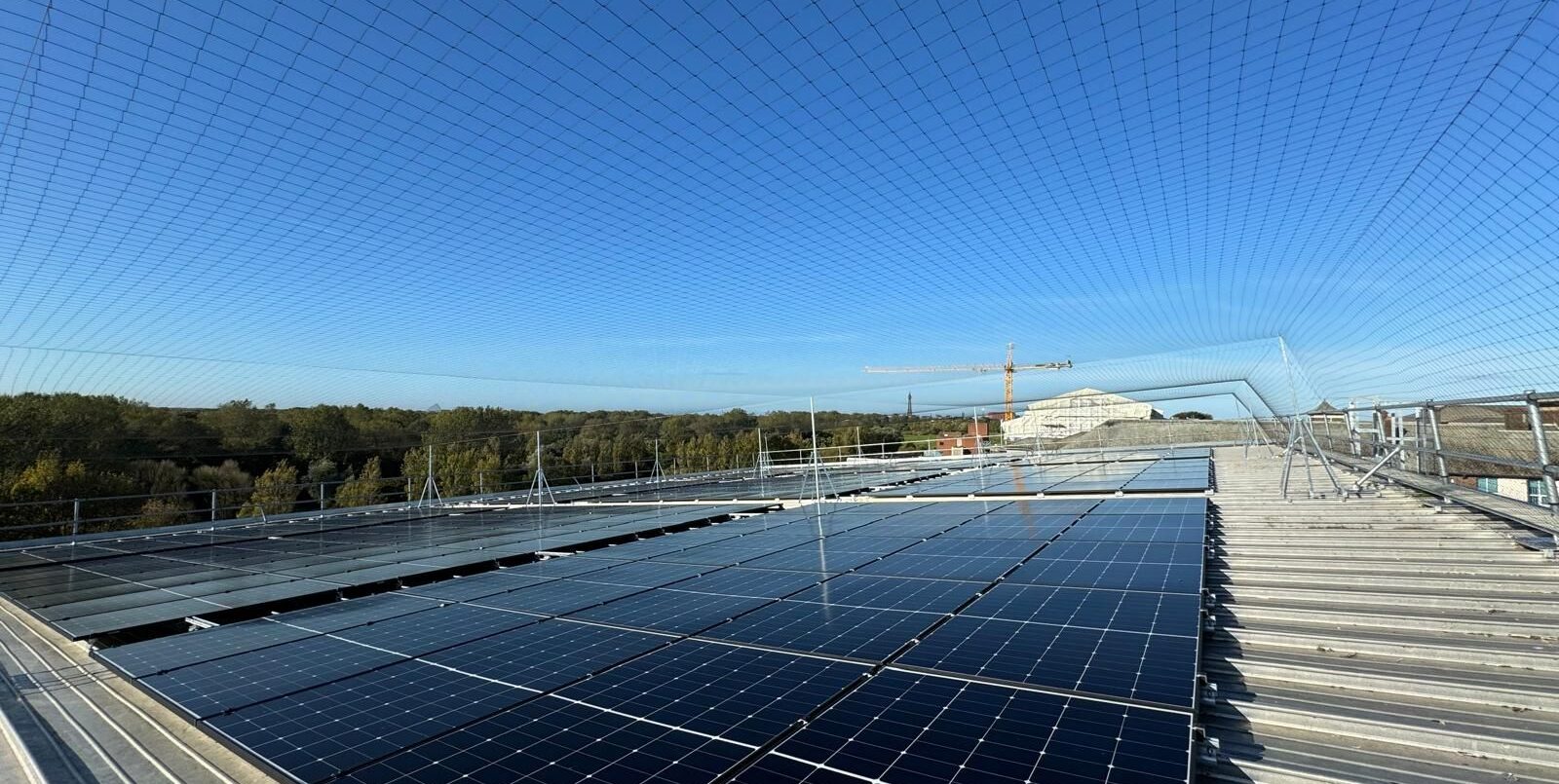
Solar PV panels represent one of the most frequent sources of pigeon-related challenges across Canary Wharf. The gap that is present between the panels themselves and the underlying roof tiles provides a sheltered, warm environment that continues to be attractive throughout every season, luring birds to roost beneath them. The resulting accumulation of bird guano causes water damage, clogs gutters and drainage systems, and progressively deteriorates roofing materials over time.

Solar panel bird proofing operates by applying a mesh and clip system along the entire perimeter of each panel to completely seal the gap beneath. The clip system is secured around the panel frame without ever breaching the panels or reducing their output, whilst the mesh installation itself stops birds from nesting underneath and means the problem does not return with each changing season.
Pest Bird Species in Canary Wharf
{Feral pigeons and gulls are behind the lion’s share of bird pest enquiries received across Canary Wharf, though starlings, sparrows, and a range of other species are similarly capable of causing fouling, noise, and structural damage to properties throughout the area. Pigeons are ideal for immediate proofing solutions. Gulls, however, are afforded legal protection and therefore require a carefully considered course of action that is shaped entirely by whether or not nesting activity is already underway.}
Feral pigeons in Canary Wharf
Feral pigeons stand as one of the most prevalent pest bird found throughout Canary Wharf, taking up residence on building ledges, fire escapes, rooftops, and bridge structures right across the area, generating substantial quantities of bird droppings that bring about a significant public health and safety concern whilst creating considerable ongoing maintenance costs for those responsible for managing properties.

Bird guano produced by feral pigeons is acidic and actively hastens the corrosion of both metal surfaces and stonework. The waste itself can contain salmonella alongside various harmful pathogens, and RSPH guidance firmly identifies bird waste as a considerable public health risk for commercial premises, particularly in locations where birds are present above food storage or preparation areas.
Gulls and seagulls in Canary Wharf
Seagulls have been establishing nesting colonies on Canary Wharf’s rooftops for several decades and have, over that time, grown considerably accustomed to human presence outside of the breeding season. Once eggs have been laid, routine access to the roof becomes unworkable, outdoor spaces situated directly beneath the nest become hard to occupy, and both the swooping behaviour and persistent calling escalate considerably until the chicks reach fledging age in late summer.
Pigeons and seagulls regularly favour the same rooftops, yet handling gull populations presents a considerably more substantial challenge. Gulls are larger and more long-lived birds that reliably come back to matching nesting locations season after season, and they are afforded full legal protection under the Wildlife and Countryside Act 1981.
Dismantling a gull nest or collecting its eggs without the appropriate licence is forbidden under current legislation. Our team operates fully within the relevant legal framework governing pest management in relation to protected species, offering straightforward guidance on the actions that may be taken without delay alongside those that will require a formal licence application, supported by recorded evidence of public health or safety concerns.
Bird Proofing for Canary Wharf Properties
Securing a Canary Wharf property against pest birds requires thoughtful selection of the optimal deterrent method for the specific building in question. Bird spikes operate dependably on narrow ledges, yet they fail to provide adequate coverage across wider surfaces, whilst netting that has been mis-specified for either the bird species or the structure will give birds immediate access through the resulting gaps.
Our pest control technicians perform a full site assessment prior to suggesting any solution. The survey encompasses the entire structure rather than only the most apparent roosting locations, given that birds will migrate to neighbouring surfaces once the most favourable ones have been treated.
Our bird control measures utilise exclusion and deterrence techniques to keep birds from nesting on roofs and ledges. We help clients on which approach is most suitable for the species involved and the legal protections that apply, so that every solution we provide is both successful and humane.
Non-lethal bird management relies on mechanical exclusion as its core approach, with pigeon proofing and deterrence covering most residential and commercial work without requiring licensed lethal control.
We also offer deliver pest management contracts for Canary Wharf properties, covering planned inspections, compliance reports for environmental health purposes, and a rapid response service should any fresh bird activity be identified between visits.
