


Bird Control Services in Bray
We implement a range of bird control methods to discourage and remove pest birds from both residential and commercial properties. The most efficient mix will depend upon the building itself, the species involved, and the extent of the infestation, which is why our pest control technicians conduct a full site survey before making any recommendations.

Bird spikes and bird wire
Bird spikes and bird wire rank among the most widely used systems for stopping birds from landing on ledges, window sills, parapet walls, and roof ridges. Standard stainless steel spikes cover flat ledge surfaces and prevent birds from roosting without causing them harm.

Bird wire systems work by attaching steel springs and wires between pillars or anchor points across ledges and built surfaces, producing an insecure landing zone that prevents birds from settling. Once correctly installed, both systems are engineered to endure harsh weather conditions with little ongoing maintenance required.
Bird netting in Bray
Bird netting serves as a highly effective exclusion method, sealing off expansive areas such as roof voids, loading bays, the underside of canopies and bridges, and open courtyards. When specified correctly, it prevents birds from nesting and roosting within a given space altogether.

Pigeon netting and gull grade netting use various mesh sizes to address each species. Our pest control technicians specify the mesh gauge, fixing system and support structure for the site because netting installed with the wrong gauge allows birds access through gaps almost immediately.
Falconry and birds of prey
Falconry services employ trained hawks and other birds of prey to chase pest birds away from a site. A bird of prey’s presence shatters established roosting patterns and forces birds in urban environments off the site completely.
Scheduled falconry visits are planned throughout and beyond the breeding season, with the programme being maintained right up until the site is no longer being used as a roost. Using hawks as a reliable humane bird deterrent works best on open sites like car parks, stadiums, retail parks and large rooftops!
Solar panel bird proofing
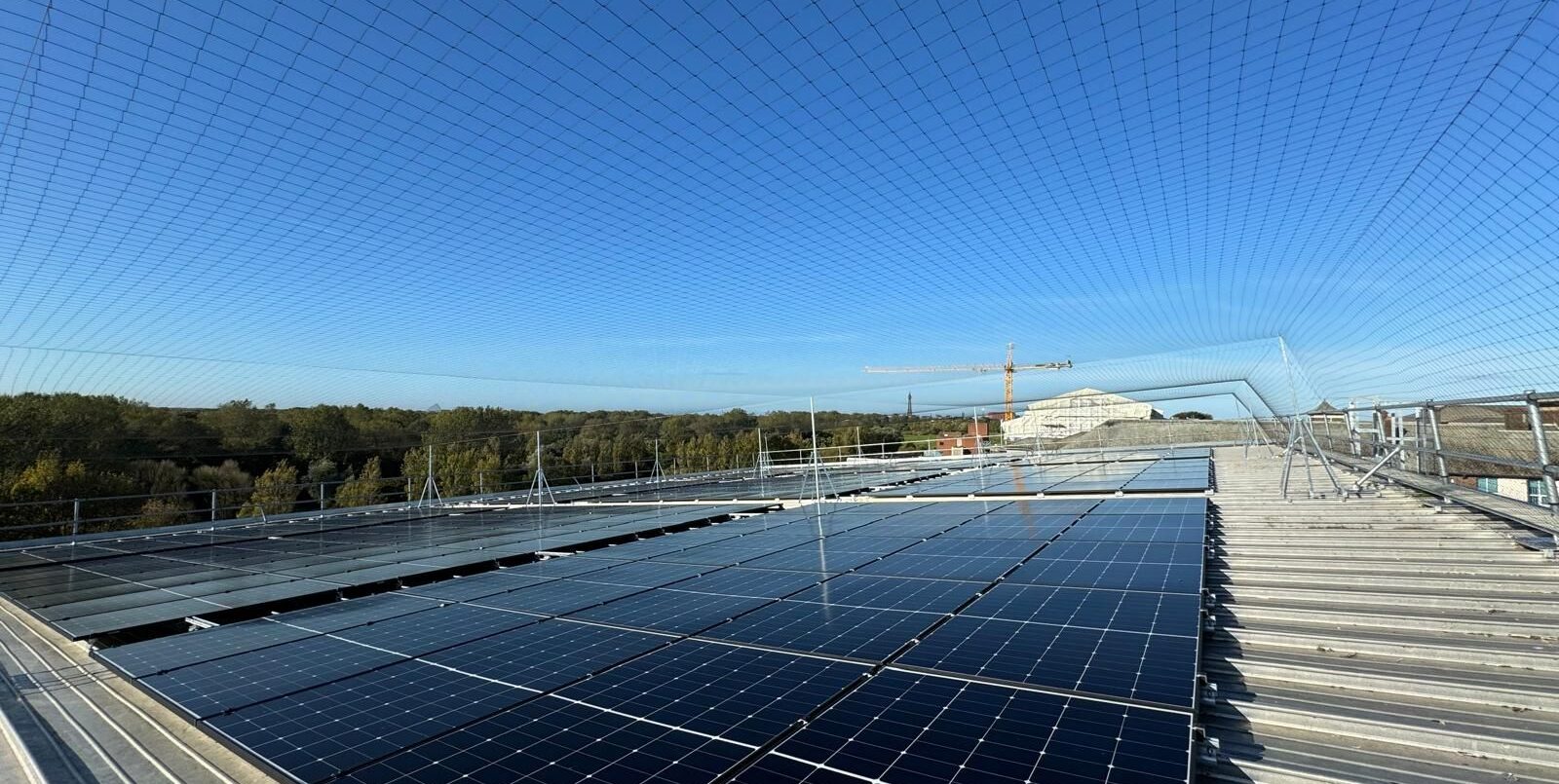
Solar panels are a common source of pigeon-related issues across Bray. The gap that sits between the panels and the roof tiles offers birds a covered and temperate environment during every season{s}, and when pigeons nest beneath them, the resulting bird guano can bring about moisture damage, blocked gutters and drains, and the gradual deterioration of roofing materials.

PV panels bird proofing involves fitting a mesh and clip system around the perimeter of each panel to completely seal the underlying gap. The clip system holds firmly around the panel frame without penetrating the panels themselves or compromising their energy output, whilst the mesh acts as a reliable barrier that stops birds from nesting beneath the panels and ensures the problem does not return year after year.
Pest Bird Species in Bray
Feral pigeons and gulls are responsible for the lion’s share of bird pest call outs across Bray, though starlings, sparrows and a variety of other species are just as capable of causing fouling, noise and structural damage to properties throughout the area. Pigeons? They can be proofed against right away! Gulls are a different story entirely though, as they are protected by law, meaning the approach taken will vary depending on whether or not nesting is already underway.
Feral pigeons in Bray
Feral pigeons are the most prevalent pest bird species found throughout Bray. They set up roosting and nesting sites on ledges, fire escapes, rooftops, and bridge structures across the area, leaving considerable quantities of bird droppings that present a public health and safety concern whilst creating significant and ongoing maintenance costs for property managers.

Feral pigeon guano is inherently acidic in composition and directly accelerates the deterioration of both metal finishes and stonework through caustic chemical action. The droppings themselves are known carriers of salmonella and a range of additional pathogens of concern, and guidance issued by the Royal Society for Public Health firmly identifies bird waste as a substantial public health risk for commercial premises, particularly where birds are active in proximity to food storage or preparation areas.
Gulls and seagulls in Bray
Seagulls have established Bray’s rooftops their territory for many years now and have grown mostly at ease in the presence of people during the more peaceful months away from breeding season. The moment eggs appear, however, things change completely. Normal access to the roof is interrupted, outdoor spaces sitting directly beneath the nest become practically impossible to occupy, and the relentless diving and crying reaches a crescendo that does not let up until the young birds finally fledge in the later weeks of summer.
Pigeons and seagulls regularly inhabit the same rooftops, yet controlling gull populations poses a significantly more significant challenge. Gulls are more sizeable and longer living birds that consistently go back to exact nesting locations season after season, and they receive full legal protection under the Wildlife and Countryside Act 1981.
Removing a gull nest or interfering with its eggs without the appropriate authorisation is strictly prohibited under current legislation. Our team operates entirely within the established legal parameters governing pest management in relation to protected species, providing clear guidance on which interventions may be undertaken without delay and which demand a formal licence application, supported by documented evidence of public health or safety concerns.
Bird Proofing for Bray Properties
Safeguarding a Bray property from pest birds necessitates a strategic solution that is wholly matched to the building in question. Bird spikes do an excellent job on narrow ledges yet fail to provide adequate coverage across wider surfaces, whilst netting that has been mis-specified for either the species or the structure will provide birds immediate access through any gaps that remain.
Our pest control technicians carry out a full site survey before advising on any system whatsoever. Every corner of the building is evaluated, not merely the most apparent roosting points, because birds will inevitably shift to neighbouring surfaces once the preferred locations have been treated.
Our bird control methods implement exclusion and deterrence techniques to prevent birds nesting on roofs and ledges. We guide clients on the most suitable approach for each species, taking into account all relevant legal protections, and every solution we deliver is both practical and humane.
Physical deterrence remains the foundation of ethical bird control, with pigeon proofing and deterrent methods fulfilling the large majority of both residential and commercial requirements, entirely eliminating the need for licensed lethal intervention.
We deliver pest management contracts for Bray properties covering scheduled visits, compliance reports for environmental health purposes, and rapid attendance between visits should fresh bird activity be identified.
