


Bird Control Manchester Experts on Common Local Pest Bird Species
The management of pest bird species across Ardwick requires a tailored approach for each situation encountered. The specific species involved will determine the legal framework that applies, the method of control we advise, and the timeframe within which the work must be completed. The following covers the bird species our control team encounters most frequently throughout Manchester.
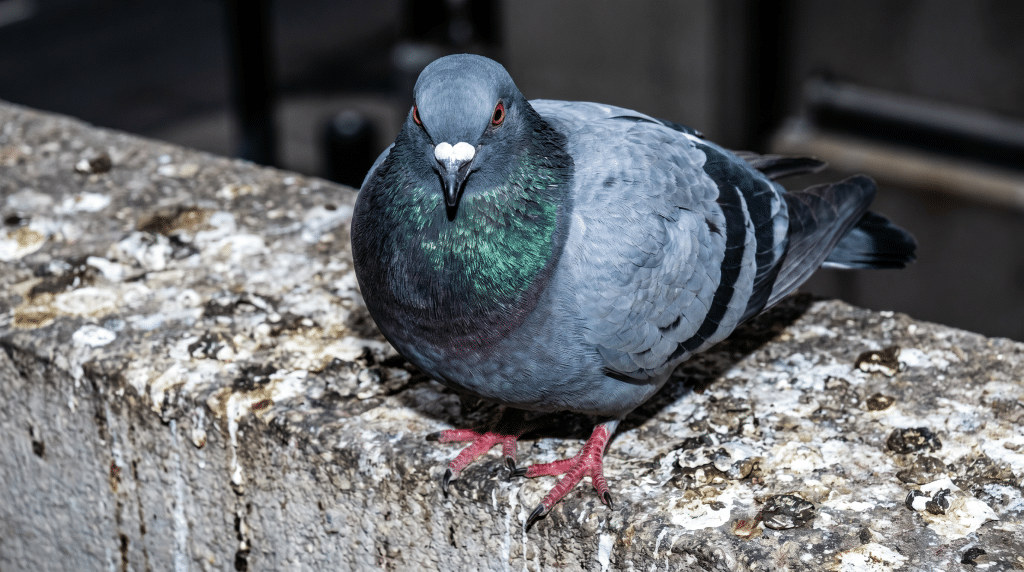

Feral pigeons (Columba livia)
Feral pigeons represent the most prevalent avian pest problem across Manchester city centre, as well as on the industrial estates and retail parks that extend throughout the Manchester area. For example, Piccadilly Gardens has supported a substantial, year-round pigeon population for many decades, and from this established base the birds have spread out to commercial rooftops, multi-storey car parks, railway arches, and large warehouse units right across the region.
An uncleared breeding pair can generate multiple broods annually, and a pigeon roost left unmonitored in a ledge space or roof void will develop into a major bird infestation in only two breeding seasons.
Bird fouling from feral pigeons is corrosive. Left to build up, it harms roofing membranes and clogs drainage channels, whilst contact with metal fittings and structural steelwork speeds up corrosion over time. Feral pigeons are not protected under the Wildlife and Countryside Act 1981, so pest control treatment and deterrent work can go ahead without a licence. Our pigeon control service offers the full range of exclusion and deterrence methods.
Gulls (Laridae)
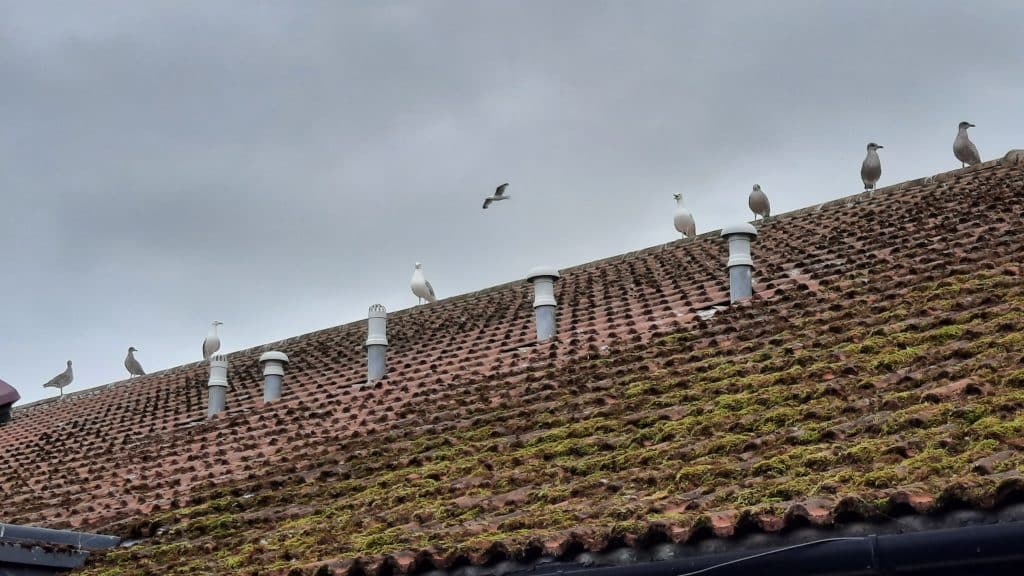
Gull populations have been moving consistently inland across Manchester for many years. Both herring gulls and lesser black-backed gulls have set up nesting colonies upon flat commercial rooftops throughout the Ardwick area, attracted by the abundance of food waste generated by restaurants, retail parks, and waste handling sites, as well as the residual warmth that large warehouse rooftops retain during the breeding season.
Breeding gulls grow increasingly protective and territorial over their chosen sites, meaning that well-established colonies can pose a real safety risk to maintenance personnel carrying out day-to-day roof access work.
Gulls enjoy protected status under the Wildlife and Countryside Act 1981, meaning active nests simply cannot be disturbed without the proper licensing in place. Natural England provides general licences, including GL41 which covers public health and safety, and these permit licensed pest control companies to carry out specific approved control activities.
Our gull control service works strictly in line with the boundaries of the law, advising you on what measures are permitted during the current season whilst pinpointing the most suitable deterrent systems to prevent birds from reappearing to the same rooftop the following year.
Starlings, sparrows, and corvids
Starlings roosts cause rapid and considerable fouling across commercial properties throughout Ardwick during the autumn and winter months, with dry guano posing an identical health hazard to that caused by pigeon droppings.
Domestic sparrows frequently set up their nests inside roof voids and beneath unsecured fascias across household and industrial properties in Ardwick. As a protected species, the schedule and method of any action must be closely considered and properly managed.
Carrion crows, blackjackdaws and common magpies are corvids you will routinely come across on industrial sites throughout Greater Manchester, and when these birds construct nests inside chimneys or flues they present a serious fire hazard that must be addressed outside of the nesting season. We spot pigeons and any other pest bird species present during our survey and then structure the entire programme around the specific legal protections that apply to each one.
Bird Control Services Throughout Ardwick
Our pest management technicians carry out a comprehensive assessment ahead of advising on any bird control solution. The species in question, the character of the building, and the extent of the infestation all inform the final specification. The greater part of commercial projects call for a blend of bird control methods rather than a solitary approach, as pest birds will relocate to neighbouring surfaces once a single landing point has been eliminated. The following range of services shows what we use across Ardwick and its surrounding areas.

Bird netting
Bird netting offers full exclusion across large open spaces, including loading bays, roof voids, canopies, and internal courtyards where pigeons nest and roost in substantial numbers. A correctly specified netting system prevents all bird access to the treated area and continues to be effective for a decade when periodically inspected. Our pest control technicians hold PASMA and IPAF certifications, enabling safe installation at height on Ardwick’s higher commercial and industrial buildings, a capability that many local pest control providers simply cannot offer. Pigeon grade and gull grade netting require different mesh apertures, and selecting the incorrect gauge allows birds to pass through the gaps within a few days of installation.
Bird spikes
Bird spikes are used to discourage pest birds from perching on ledges, parapets, window sills, signage, and roof ridges. The appropriate specification of bird spike is decided by both the width of the surface in question and the species requiring management: more compact arrangements are appropriate to smaller birds, whilst wider spacing is more appropriate for pigeons and gulls. Bird spikes provide a humane and considered approach to bird control. Their blunt-tipped prongs leave the surface sufficiently uncomfortable to discourage landing or roosting, whilst causing no actual harm to the birds themselves.
Bird wire and post systems
Bird systems employ tensioned stainless steel wire run between subtle low-profile posts, engineering an unstable landing surface across broader ledges and stone sills where spike systems would create an unacceptable visual intrusion. The installation carries an minimally minimal footprint when seen from street level, making it as the preferred solution for visible commercial façades and heritage buildings throughout Ardwick city centre. Wire systems remain particularly effective as a deterrent against gulls, which find it difficult considerably to make reliable use of an uncertain and unstable surface.
Audible and visual bird scarers
Audible bird scarers produce predator calls and distress signals at varying intervals to prevent birds from roosting on a site. Visual scarers feature realistic replicas of birds of prey to create a sense of danger across rooftops and ledges. Both categories of bird deterrent system perform best when used in conjunction with physical exclusion measures, as birds will gradually become accustomed to a solitary scarer operating on a predictable cycle and will ultimately no longer respond to it.
Falconry
Our falconry team takes trained hawks and birds of prey out to disperse established pest bird populations from commercial premises. The presence of a live bird of prey disturbs roosting and nesting behaviour much more effectively than static bird control measures across large open rooftops and outdoor areas. Falconry visits are closely scheduled throughout the breeding season and continue until the site is no longer being used as a roost. The handler records every single visit and provides written compliance records if requested.
Bird nest removal and trapping
Active bird nests are protected under the Wildlife and Countryside Act 1981, but when the nesting season concludes, existing nests must be cleared before deterrents are fitted. Old nesting material harbours parasites and holds on to the scent that lures birds back to the same spot year after year. Our licensed technicians clear the nest, clean the area of guano and debris, and install the appropriate deterrent systems in a single visit. Where pigeon populations are large and deterrents alone prove insufficient, a targeted bird trapping programme can reduce numbers enough for exclusion to hold. Trapping typically runs between six and eight weeks.

Bird fouling removal
Built-up bird guano requires management as a hazardous material throughout the removal process. Once dried, droppings disintegrate into a fine particulate dust capable of carrying Salmonellosis and other harmful pathogens, which pose a serious health risk if inhaled without adequate respiratory protection during cleaning. Our bird fouling removal service thoroughly removes and disinfects all affected areas before any exclusion work is undertaken. This pre-cleaning process eliminates the biological scent that would otherwise attract birds directly back through any gaps within a newly installed deterrent system.
Why Pest Bird Problems Cost More Than They First Appear
Bird guano is sufficiently acidic to degrade a flat roof membrane within the course of a one season. The cumulative damage resulting from an unmanaged bird infestation across a Ardwick commercial property extends across drainage systems, structural steelwork, electrical equipment and fire safety infrastructure, generating consequential costs that frequently surpass the expenditure associated with professional bird control measures themselves.
Structural damage and guano corrosion
Drainage channels clogged by bird droppings and nesting material cause water to collect and enter the structural fabric of the building below. Commercial solar panel installations throughout Greater Ardwick face a distinctly serious pest-related risk, whereby guano builds up beneath the panels, compromises drainage pathways, and nesting material pressed against electrical connections or junction boxes introduces a fire hazard that the majority of property owners only become aware of during a routine maintenance inspection.
Fire risk from nesting materials
Bird nests found in roof voids, chimney flues, or near electrical wiring genuinely pose a serious fire risk! Parched nesting material is highly flammable, and discovering bird nests close to junction boxes or beneath rooftop plant equipment is a remarkably common occurrence across Ardwick’s older commercial properties. Clearing out that dry nesting material during the fall window between breeding seasons eliminates the danger long before the following winter begins.
Disease and health risks
Birds are identified hosts of over 60 distinct diseases. Salmonellosis, E. coli, Campylobacter, Psittacosis, Cryptococcosis, and Histoplasmosis constitute the commonly documented diseases associated with pest bird fouling and nesting debris. Histoplasmosis is a fungal infection caused by airborne spores found in dried droppings, and the associated health risk becomes most acute when guano is disturbed in the course of cleaning operations conducted without appropriate respiratory protection in place.
For catering operators and leisure operators across Ardwick, pest bird activity near delivery bays, kitchen extractor vents, or open food storage poses both a regulatory issue and a serious health concern. An environmental health inspection that identifies active bird fouling or nest material in proximity to food production areas can result in the issuance of an improvement notice, or a requirement to cease trading whilst remedial works are carried out.
Secondary infestations
Nest material and bird fouling are well known attractants for subsequent pest populations. Fleas and bird mites that establish themselves within nesting debris will move into the building once the birds depart at the close of the season, whilst the warmth generated by accumulated guano and its organic content draws further insect activity. Addressing the nesting site as part of an active programme eliminates this secondary pest risk before it has the opportunity to move indoors.

Commercial Bird Pest Control Service Across Ardwick
Commercial bird pest control in Ardwick serves a wide range of business environments, from food businesses, hospitality venues, retail units and healthcare facilities through to the vast warehousing, industrial and logistics operations scattered across Greater Ardwick and into Cheshire. The greater part of this work unfolds in regular cooperation with site managers and dedicated property teams. Appointments scheduled outside of standard business hours are completely routine, written compliance documentation is delivered as an essential part of every job, and our technicians carry out all work with calm professionalism on any premises where customers are present.
Pest Solutions oversees rodent control, insect treatments, wasp nest removal and commercial pest contracts throughout Ardwick, meaning commercial clients managing various pest challenges can manage everything smoothly through one dedicated pest control company.
Our commercial bird control programmes are founded on integrated pest management (IPM) principles, uniting exclusion, deterrence, and population management into one integrated bespoke strategy. For commercial properties requiring structured oversight, we supply regular pest management contracts that encompass scheduled surveys, prompt emergency response between visits, and detailed written reports suitable for environmental health or insurance purposes.
Our business bird control programme begins with a complimentary site survey. We identify the most suitable methods for the building and organise all installations around your ongoing operations. Written records of every task completed are supplied for compliance and insurance purposes. The programme is built for long term control, with deterrents specified to serve for a decade, regular inspections to identify new pressure early, and documented evidence of every visit kept on file.